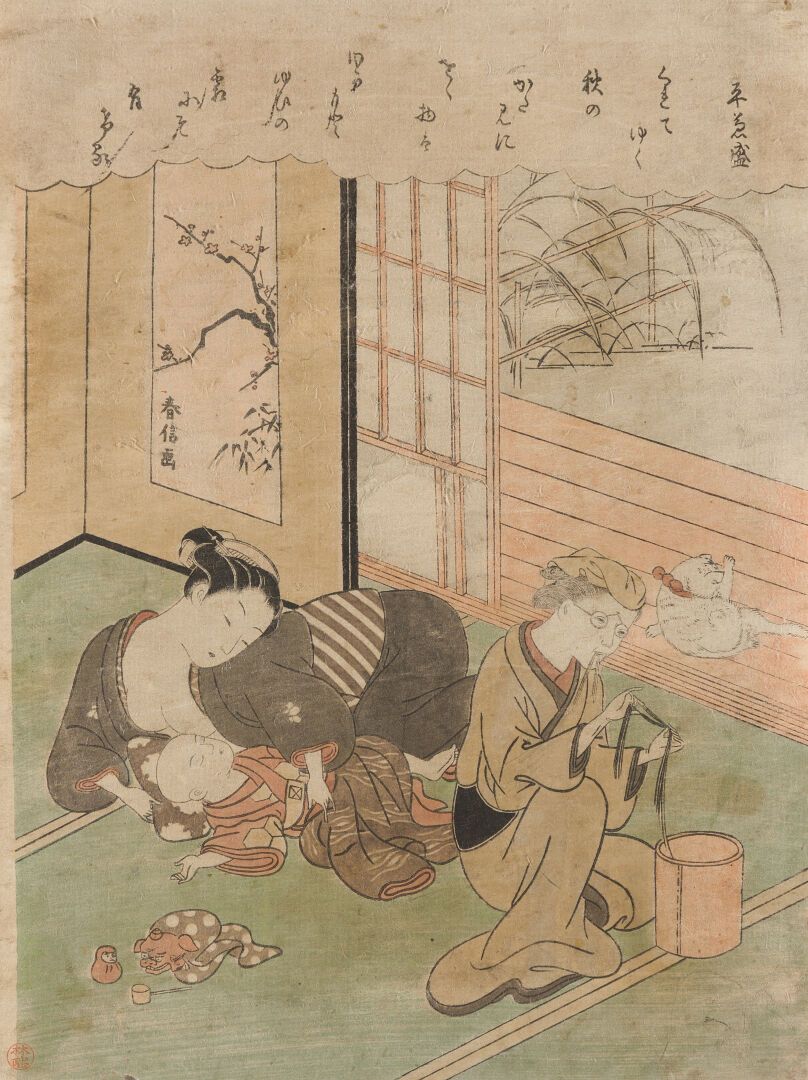
Suzuki Harunobu (1725 ? -1770), Autumn evening autumn evening, ca. 1767/68 Format chban, 28,7 x21,5 cm Nishiki-e print, ink and polychrome on paper representing a young woman woman lying next to her child while an elderly woman woman pulling lengths of threads. It is illustrated with a waka poem by the poet Taira no Kanemori (10th c.) which reads as follows: Kurete yuku aki no katami ni oku mono wa waga motoyui no himo ni zo arikeru. Autumn is going away and leaves behind its frost on my hair. From an untitled series illustrating classical poems, Harunobu created many works based on classical poems. The figure on the right of the old woman kneeling by a wooden box from which she is pulling lengths of thread is taken directly from a book by Harunobu: Ehon hana kazura, vol. III ¥"ªá where the same image of this old woman is shown. And the reference of the poem of frost on the hair is a metaphor of the hair turning white with age. Harunobu's use of the figure in this quiet, poetic scene is a fine example of the sense of transformation that is at the heart of ukiyo-e and so much other Japanese art. Stamp of the Tadamasa Hayashi collection. Wear and stains, small missing at lower left. Provenance: Jeannette Ostier Gallery
Estimate
€1,800 - €2,000
Result
Not communicated
Buyer's premium
29%
Suzuki Harunobu
(1725 ? -1770), Autumn evening
autumn evening, ca. 1767/68
Format chban,
28,7 x21,5 cm
Nishiki-e print, ink
and polychrome on paper
representing a young woman
woman lying next to her
child while an elderly woman
woman pulling lengths of
threads. It is illustrated with a
waka poem by the poet Taira
no Kanemori (10th c.) which reads
as follows:
Kurete yuku
aki no katami ni
oku mono wa
waga motoyui no
himo ni zo arikeru.
Autumn is going away
and leaves behind
its frost
on my hair.
From an untitled series illustrating classical poems, Harunobu created many works based on classical poems. The figure on the right of the old woman kneeling by a wooden box from which she is pulling lengths of thread is taken directly from a book by Harunobu: Ehon hana kazura, vol. III ¥"ªá where the same image of this old woman is shown. And the reference of the poem of frost on the hair is a metaphor of the hair turning white with age.
Harunobu's use of the figure in this quiet, poetic scene is a fine example of the sense of transformation that is at the heart of ukiyo-e and so much other Japanese art.
Stamp of the Tadamasa Hayashi collection.
Wear and stains, small missing at lower left.
Provenance:
Jeannette Ostier Gallery
Sale
Tuesday 8 November 2022・13:30 (Europe/Paris)
Salle 1 - Hôtel Drouot
9, rue Drouot
75009 Paris