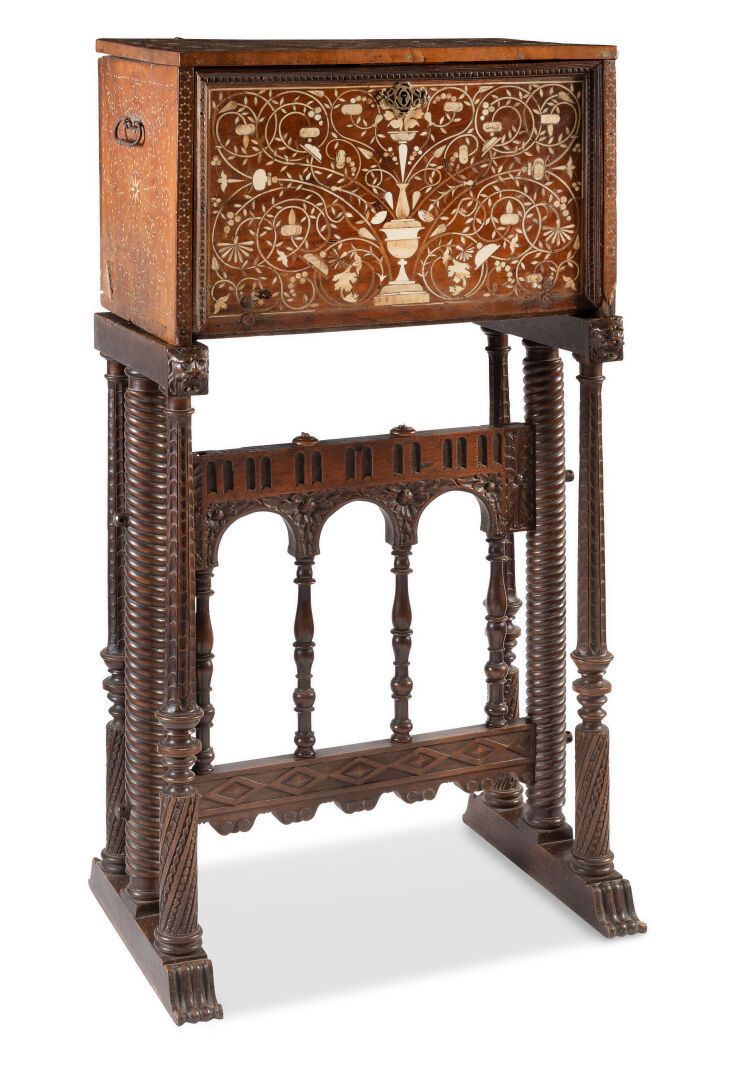
Large "escritorio" mudejar cabinet, Spain, probably late 16th - early 17th century Rectangular wooden cabinet opening on the front with a hinged flap and lock, and a lid on top. The interior is divided into five drawers with metal grips, the sides fitted with metal handles. Each side (except the back and base) is inlaid with bone, sometimes regrained, and light-colored wood, forming a variety of decorations: geometric rosette decoration on the lid, inside the front flap and on the sides; vases decorated with foliate scrolls on the front and in pairs under arcatures inside the lid, and foliate scrolls on the drawer fronts. With its key, it stands on an architectural base of turned wood columns and arches, with lion paw feet and lion protome supports. 35.5 x 56.8 x 32.1 cm; base 79.5 x 58.5 x 41.5 cm Slightly missing inlays, accidents to the wood (cracks, small missing parts), small woodworm holes, traces of oxidation on the fittings, accidents and missing parts to the base. A cabinet of the same type, with the same vase motif and a base of similar shape, is in the Victoria and Albert Museum, London, under inventory no. 294-1870.
Estimate
€2,000 - €4,000
Result
€2,636
Buyer's premium
30%
Large "escritorio" mudejar cabinet, Spain, probably late 16th - early 17th century
Rectangular wooden cabinet opening on the front with a hinged flap and lock, and a lid on top. The interior is divided into five drawers with metal grips, the sides fitted with metal handles. Each side (except the back and base) is inlaid with bone, sometimes regrained, and light-colored wood, forming a variety of decorations: geometric rosette decoration on the lid, inside the front flap and on the sides; vases decorated with foliate scrolls on the front and in pairs under arcatures inside the lid, and foliate scrolls on the drawer fronts. With its key, it stands on an architectural base of turned wood columns and arches, with lion paw feet and lion protome supports.
35.5 x 56.8 x 32.1 cm; base 79.5 x 58.5 x 41.5 cm
Slightly missing inlays, accidents to the wood (cracks, small missing parts), small woodworm holes, traces of oxidation on the fittings, accidents and missing parts to the base.
A cabinet of the same type, with the same vase motif and a base of similar shape, is in the Victoria and Albert Museum, London, under inventory no. 294-1870.
Sale
Tuesday 1 October 2024・13:30 (Europe/Paris)
Salle 4 - Hôtel Drouot
9, rue Drouot
75009 Paris