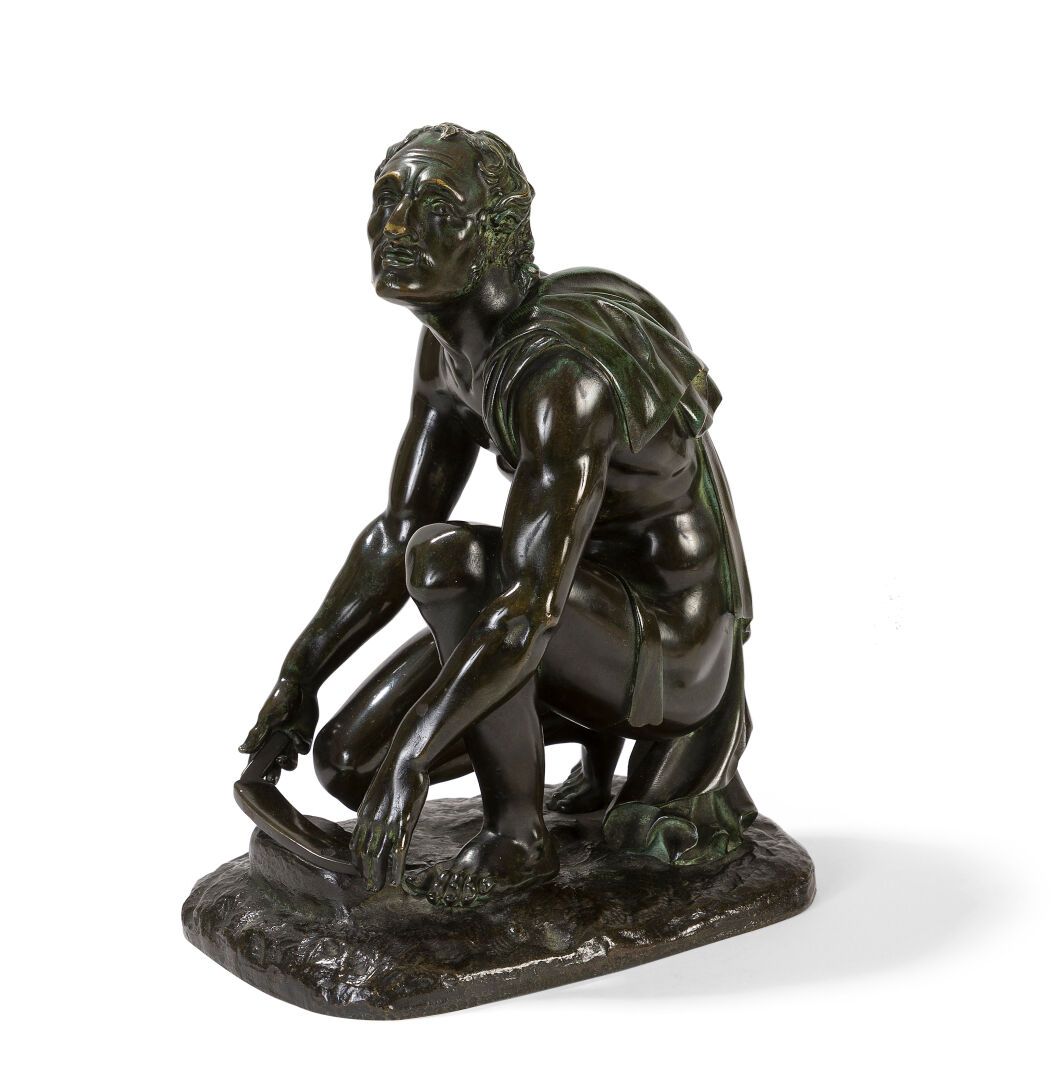
19th century French school after the antique The Arrotino or the Skinning Scythian or the Remover Bronze sculpture with greenish-brown patina H. 22.5 cm (wear and accident to the nose) Related works : - Giovanni Battista Foggini (1652-1725), Arrotino, copy after the antique, white marble, H. 110, W. 105, D. 51 cm, Paris, Musée du Louvre, n°inv.MR 1853 ; - 17th-century French school, L'Arrotino d'après l'antique, bronze, cast by Vinache, Parc du château de Versailles. The original model for this bronze is an antique marble called Arrotino, or "Le Rémouleur" or "Le Scythe écorcheur", preserved in the Uffizi Palace in Florence. The work, acquired by Cardinal Ferdinand de' Medici from the Roman Mignanelli family and sent to Palermo in 1800, escaped the 1797 Treaty of Tolentino. Although the work was not sent to France, it enjoyed considerable success. The French were familiar with the antique thanks to the copy made by Foggini for the Château de Versailles, and to the numerous reductions made in bronze. In the 19th century, the Italian sculptor's copy was moved to the Tuileries and then back to Versailles, on the staircase of the park's northern parterre, as a counterpart to Coysevox's Crouching Venus, cast by the Keller brothers.
Estimate
€200 - €400
Result
€422
Buyer's premium
30%
19th century French school after the antique
The Arrotino or the Skinning Scythian or the Remover
Bronze sculpture with greenish-brown patina
H. 22.5 cm
(wear and accident to the nose)
Related works :
- Giovanni Battista Foggini (1652-1725), Arrotino, copy after the antique, white marble, H. 110, W. 105, D. 51 cm, Paris, Musée du Louvre, n°inv.MR 1853 ;
- 17th-century French school, L'Arrotino d'après l'antique, bronze, cast by Vinache, Parc du château de Versailles.
The original model for this bronze is an antique marble called Arrotino, or "Le Rémouleur" or "Le Scythe écorcheur", preserved in the Uffizi Palace in Florence. The work, acquired by Cardinal Ferdinand de' Medici from the Roman Mignanelli family and sent to Palermo in 1800, escaped the 1797 Treaty of Tolentino. Although the work was not sent to France, it enjoyed considerable success. The French were familiar with the antique thanks to the copy made by Foggini for the Château de Versailles, and to the numerous reductions made in bronze. In the 19th century, the Italian sculptor's copy was moved to the Tuileries and then back to Versailles, on the staircase of the park's northern parterre, as a counterpart to Coysevox's Crouching Venus, cast by the Keller brothers.
Sale
Tuesday 1 October 2024・13:30 (Europe/Paris)
Salle 4 - Hôtel Drouot
9, rue Drouot
75009 Paris