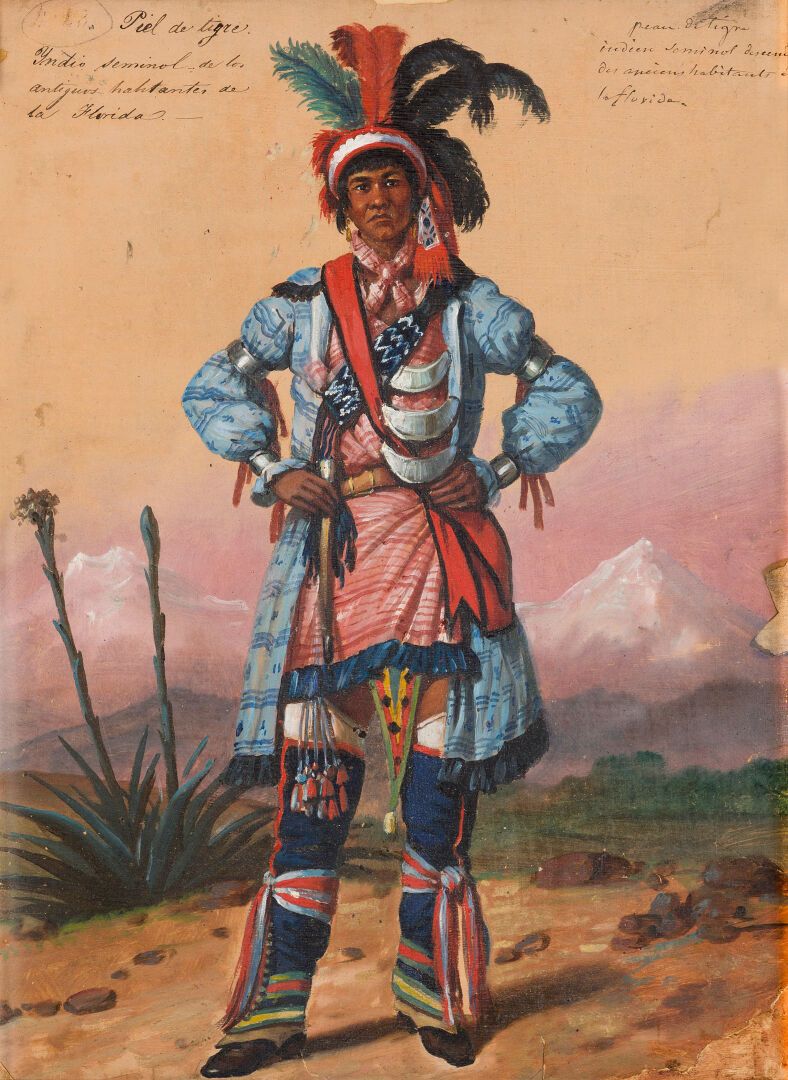
Edouard PINGRET (Saint Quentin 1788 - 1875) Portrait of a Seminole chief from Florida, tiger skin Paper mounted on cardboard 39 x 28.5 cm Inscribed in Spanish at top left "418 Piel de tigre / Indio seminol de los antiguos habitantes de / la Florida" and in French at top right "peau de tigre / indien seminol descend des anciens habitants de / la Floride". (old restorations, accidents and missing parts). Born into a wealthy family, Pingret trained with neoclassical painters Jacques-Louis David and Jean-Baptiste Régnault, then at the Saint-Luc Academy in Rome, and exhibited at the Salon from 1810. Appointed professor of fine arts in his home town of Saint-Quentin, he was a traveling painter, visiting a different region each summer to describe the customs and costumes of Switzerland, Italy and the Pyrenees (1833). He produced collections of color plates, such as Costumes des Pyrénées in 1834. In 1850, he sought inspiration in Mexico, where he exhibited at the Academia de Bellas Artes de Mexico and produced several portraits of local notables. Numerous studies similar to ours have survived, on yellowed paper or cardboard, with identical inscriptions, many of which are preserved at the Banamex Foundation in Mexico City. The Seminoles were led by Coacoochee, or Wild Cat, but another chief was Tiger Tail. The latter emigrated from Florida to Indian Territory after the Second Seminole War, and appears to have emigrated with Wild Cat's band to Mexico in 1849-50. We would like to thank Kevin Mulroy, Ph.D., University Librarian at the University of California, Los Angeles, author of the books on the Seminole Indians Freedom on the Border (1993), The Seminole Freedmen (2007), for providing us with the information contained in this leaflet and for his information on the model.
Estimate
€8,000 - €12,000
Result
€42,900
Buyer's premium
30%
Edouard PINGRET (Saint Quentin 1788 - 1875)
Portrait of a Seminole chief from Florida, tiger skin
Paper mounted on cardboard
39 x 28.5 cm
Inscribed in Spanish at top left "418 Piel de tigre / Indio seminol de los antiguos habitantes de / la Florida" and in French at top right "peau de tigre / indien seminol descend des anciens habitants de / la Floride".
(old restorations, accidents and missing parts).
Born into a wealthy family, Pingret trained with neoclassical painters Jacques-Louis David and Jean-Baptiste Régnault, then at the Saint-Luc Academy in Rome, and exhibited at the Salon from 1810. Appointed professor of fine arts in his home town of Saint-Quentin, he was a traveling painter, visiting a different region each summer to describe the customs and costumes of Switzerland, Italy and the Pyrenees (1833). He produced collections of color plates, such as Costumes des Pyrénées in 1834. In 1850, he sought inspiration in Mexico, where he exhibited at the Academia de Bellas Artes de Mexico and produced several portraits of local notables. Numerous studies similar to ours have survived, on yellowed paper or cardboard, with identical inscriptions, many of which are preserved at the Banamex Foundation in Mexico City.
The Seminoles were led by Coacoochee, or Wild Cat, but another chief was Tiger Tail. The latter emigrated from Florida to Indian Territory after the Second Seminole War, and appears to have emigrated with Wild Cat's band to Mexico in 1849-50.
We would like to thank Kevin Mulroy, Ph.D., University Librarian at the University of California, Los Angeles, author of the books on the Seminole Indians Freedom on the Border (1993), The Seminole Freedmen (2007), for providing us with the information contained in this leaflet and for his information on the model.
Sale
Tuesday 17 June 2025・14:00 (Europe/Paris)
Salle 4 - Hôtel Drouot
9, rue Drouot
75009 Paris