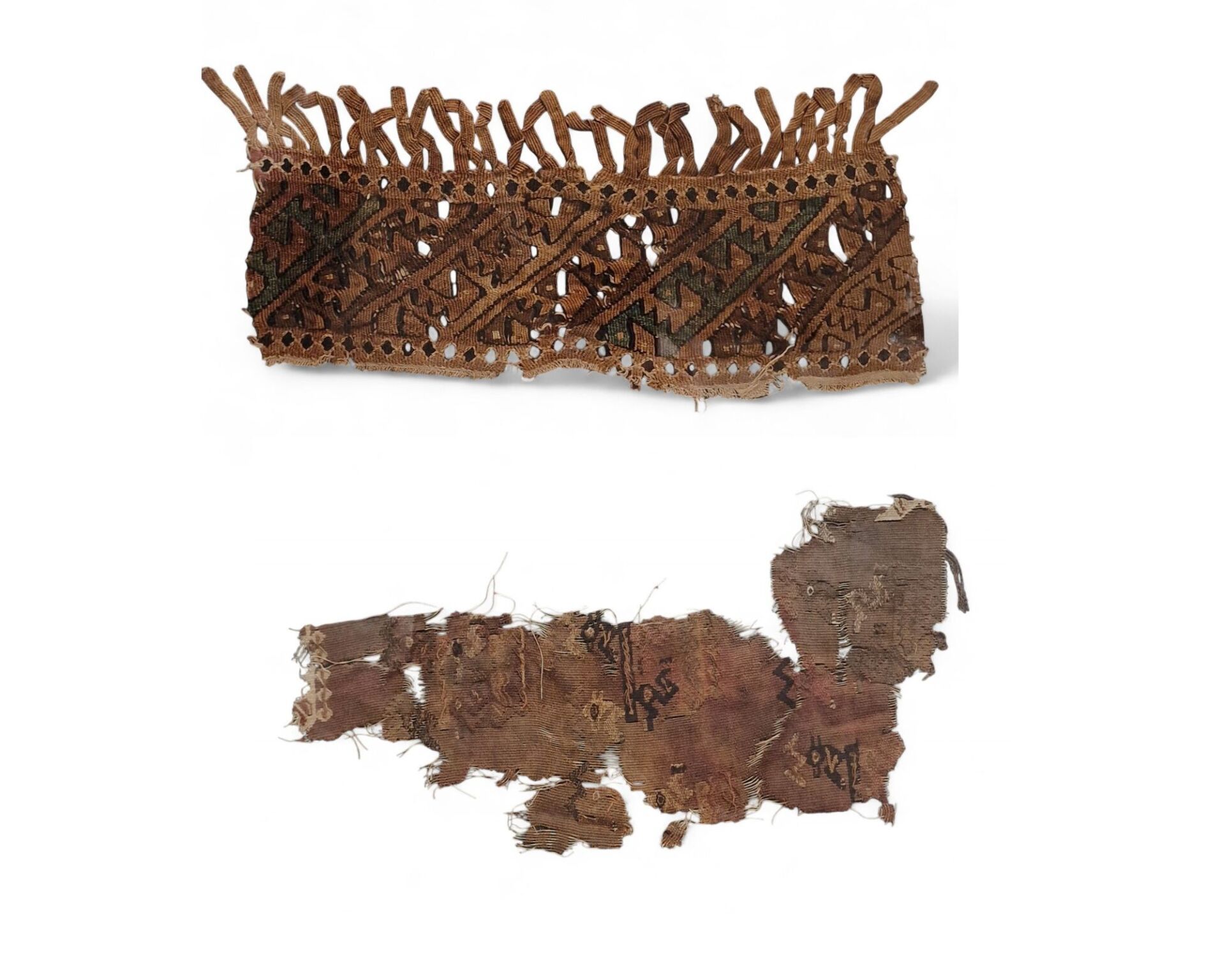
Fragment of tapestry textile decorated with black zoomorphic and geometric motifs on a brown background. Cotton fibers and camelid wool (tapestry weave). L. 36 cm x W. 20 cm Wari culture, 600-900 A.D. Peru (Ayacucho region or south coast). Condition: fragmentary, frayed edges, mounted under glass. and Fragment of a tapestry textile headband, polychrome geometric design with stylized heads in diagonal registers, cord fringe at top. Cotton fibers and camelid wool. L. 32 cm x W. 16 cm Wari culture, 600-900 A.D. Peru (Ayacucho region or south coast). Condition: fragmentary, gaps and fraying, mounted under glass. Provenance for the 2 textiles: Henri André Jean FAVRE Collection (1937-2025) (acquired before 1966, visible on a family photo dated January 1966). Sociologist, researcher and teacher, Henri Favre focused his academic work on the peasant Indian uprisings that punctuated the colonial and republican history of Latin America. He began his research at the Instituto Nacional Indigenista in Mexico, then boarded at the Institut Français d'Etudes Andines, before joining the Centre National de la Recherche Scientifique in 1966. For almost twenty years at the Institut des Hautes Etudes de l'Amérique Latine, he led a post-graduate seminar on the ethnosociology of peasant Indians in Mesoamerica and the Andes. Henri Favre was Director of Research Emeritus at the CNRS. He is the author of numerous works on the Incas, the Mayas, Peru, Mexico, the indigenous movement in Latin America...
Estimate
€100 - €150
Result
€100
Buyer's premium
34%
Fragment of tapestry textile decorated with black zoomorphic and geometric motifs on a brown background.
Cotton fibers and camelid wool (tapestry weave).
L. 36 cm x W. 20 cm
Wari culture, 600-900 A.D.
Peru (Ayacucho region or south coast).
Condition: fragmentary, frayed edges, mounted under glass.
and
Fragment of a tapestry textile headband, polychrome geometric design with stylized heads in diagonal registers, cord fringe at top.
Cotton fibers and camelid wool.
L. 32 cm x W. 16 cm
Wari culture, 600-900 A.D.
Peru (Ayacucho region or south coast).
Condition: fragmentary, gaps and fraying, mounted under glass.
Provenance for the 2 textiles: Henri André Jean FAVRE Collection (1937-2025) (acquired before 1966, visible on a family photo dated January 1966).
Sociologist, researcher and teacher, Henri Favre focused his academic work on the peasant Indian uprisings that punctuated the colonial and republican history of Latin America.
He began his research at the Instituto Nacional Indigenista in Mexico, then boarded at the Institut Français d'Etudes Andines, before joining the Centre National de la Recherche Scientifique in 1966. For almost twenty years at the Institut des Hautes Etudes de l'Amérique Latine, he led a post-graduate seminar on the ethnosociology of peasant Indians in Mesoamerica and the Andes. Henri Favre was Director of Research Emeritus at the CNRS.
He is the author of numerous works on the Incas, the Mayas, Peru, Mexico, the indigenous movement in Latin America...
Sale
Sunday 21 September 2025・18:00 (Europe/Paris)
Sale location coming soon
79, rue de Vaugirard
75006 Paris