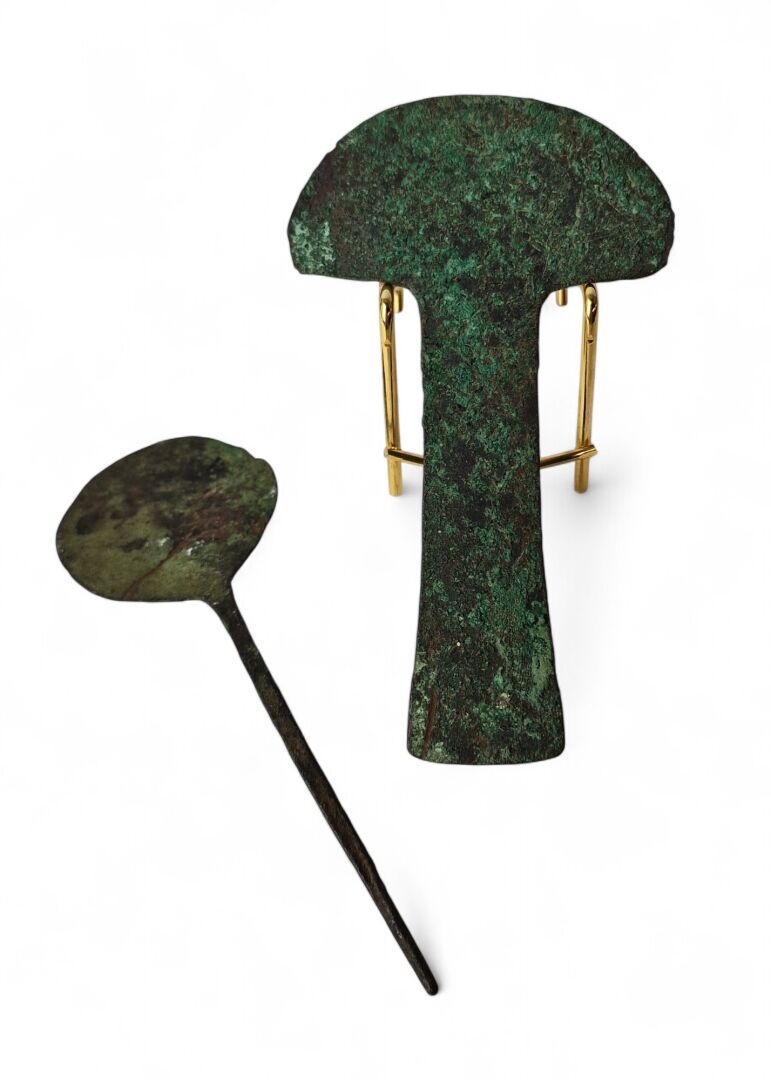
Small ceremonial tumi with trapezoidal blade and cruciform handle; textile pin (tupu) with tapered shaft and flat head. Copper alloy (copper/arsenic). Tumi: L. approx. 16 cm; Tupu: L. approx. 16 cm. Sicán-Lambayeque culture, 900-1200 A.D. Peru, north coast. Condition: green corodized patina; pin slightly corroded. Provenance: Henri André Jean FAVRE Collection (1937-2025) (probably acquired before 1970) Sociologist, researcher and teacher, Henri Favre focused his academic work on the Indian peasant insurrections that punctuated the colonial and republican history of Latin America. He began his research at the Instituto Nacional Indigenista in Mexico, then moved on to the Institut Français d'Etudes Andines, before joining the Centre National de la Recherche Scientifique in 1966. For almost twenty years at the Institut des Hautes Etudes de l'Amérique Latine, he led a post-graduate seminar on the ethnosociology of peasant Indians in Mesoamerica and the Andes. Henri Favre was Director of Research Emeritus at the CNRS. He is the author of numerous works on the Incas, the Mayas, Peru, Mexico, the indigenous movement in Latin America...
Estimate
€150 - €200
Result
€150
Buyer's premium
34%
Small ceremonial tumi with trapezoidal blade and cruciform handle; textile pin (tupu) with tapered shaft and flat head.
Copper alloy (copper/arsenic).
Tumi: L. approx. 16 cm; Tupu: L. approx. 16 cm.
Sicán-Lambayeque culture, 900-1200 A.D.
Peru, north coast.
Condition: green corodized patina; pin slightly corroded.
Provenance: Henri André Jean FAVRE Collection (1937-2025) (probably acquired before 1970)
Sociologist, researcher and teacher, Henri Favre focused his academic work on the Indian peasant insurrections that punctuated the colonial and republican history of Latin America.
He began his research at the Instituto Nacional Indigenista in Mexico, then moved on to the Institut Français d'Etudes Andines, before joining the Centre National de la Recherche Scientifique in 1966. For almost twenty years at the Institut des Hautes Etudes de l'Amérique Latine, he led a post-graduate seminar on the ethnosociology of peasant Indians in Mesoamerica and the Andes. Henri Favre was Director of Research Emeritus at the CNRS.
He is the author of numerous works on the Incas, the Mayas, Peru, Mexico, the indigenous movement in Latin America...
Sale
Sunday 21 September 2025・18:00 (Europe/Paris)
Sale location coming soon
79, rue de Vaugirard
75006 Paris