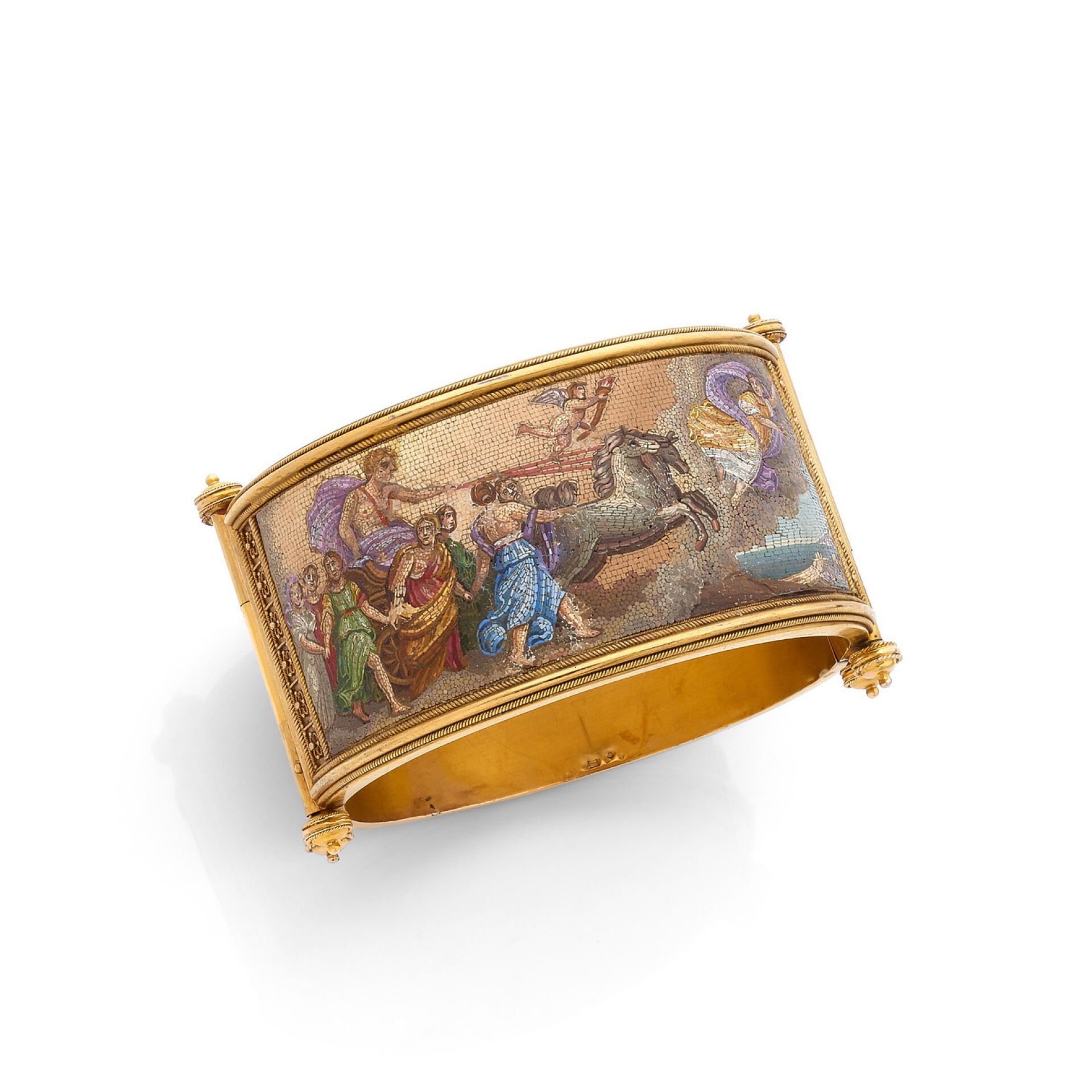
a Yellow gold bracelet adorned with a micromosaic - Italy, circa 1840 The jewel takes the form of a wide, rigid opening cuff in 585 ‰ gold, finely decorated on the reverse with geometric granulation motifs and hinged by a pin hinge. Its upper part is adorned with a remarkable micromosaic depicting Guido Reni's famous fresco L'Aurore (1613-1614), preserved at the Palazzo Pallavicini-Rospigliosi in Rome. The scene depicts Apollo driving the chariot of the Sun, preceded by Aurora, who spreads her flowers and heralds the day, accompanied by Phosphoros, the winged Love bearer of light. With its fine execution and harmonious colors, this micromosaic illustrates the refinement of Roman art in the first half of the 19th century. PB. 86.2 g - H. approx. 4.5 cm - D. approx. 6.3 cm (small chips, one of the round elements at hinge level needs re-soldering) In the 18th century, the rediscovery of ancient mosaics in Italy - notably at Hadrian's villa in Tivoli - sparked a new enthusiasm for this age-old art form and gave rise to the micromosaic (mosaico in piccolo). Numerous Roman glass masters distinguished themselves in this delicate discipline, assembling tiny tesserae of colored glass to form compositions often inspired by mythology or famous pictorial works. This 585 ‰ gold bracelet is in the neoclassical style characteristic of Grand Tour creations - the initiatory and educational journey undertaken by young European aristocrats between the 17th and 19th centuries, who brought back precious artistic souvenirs from Italy.
Estimate
€6,000 - €8,000
Result
€14,625
Buyer's premium
30%
a
Yellow gold bracelet adorned with a micromosaic - Italy, circa 1840
The jewel takes the form of a wide, rigid opening cuff in 585 ‰ gold, finely decorated on the reverse with geometric granulation motifs and hinged by a pin hinge.
Its upper part is adorned with a remarkable micromosaic depicting Guido Reni's famous fresco L'Aurore (1613-1614), preserved at the Palazzo Pallavicini-Rospigliosi in Rome.
The scene depicts Apollo driving the chariot of the Sun, preceded by Aurora, who spreads her flowers and heralds the day, accompanied by Phosphoros, the winged Love bearer of light.
With its fine execution and harmonious colors, this micromosaic illustrates the refinement of Roman art in the first half of the 19th century.
PB. 86.2 g - H. approx. 4.5 cm - D. approx. 6.3 cm
(small chips, one of the round elements at hinge level needs re-soldering)
In the 18th century, the rediscovery of ancient mosaics in Italy - notably at Hadrian's villa in Tivoli - sparked a new enthusiasm for this age-old art form and gave rise to the micromosaic (mosaico in piccolo).
Numerous Roman glass masters distinguished themselves in this delicate discipline, assembling tiny tesserae of colored glass to form compositions often inspired by mythology or famous pictorial works.
This 585 ‰ gold bracelet is in the neoclassical style characteristic of Grand Tour creations - the initiatory and educational journey undertaken by young European aristocrats between the 17th and 19th centuries, who brought back precious artistic souvenirs from Italy.
Sale
Tuesday 16 December 2025・13:30 (Europe/Paris)
Salle 4 - Hôtel Drouot
9, rue Drouot
75009 Paris