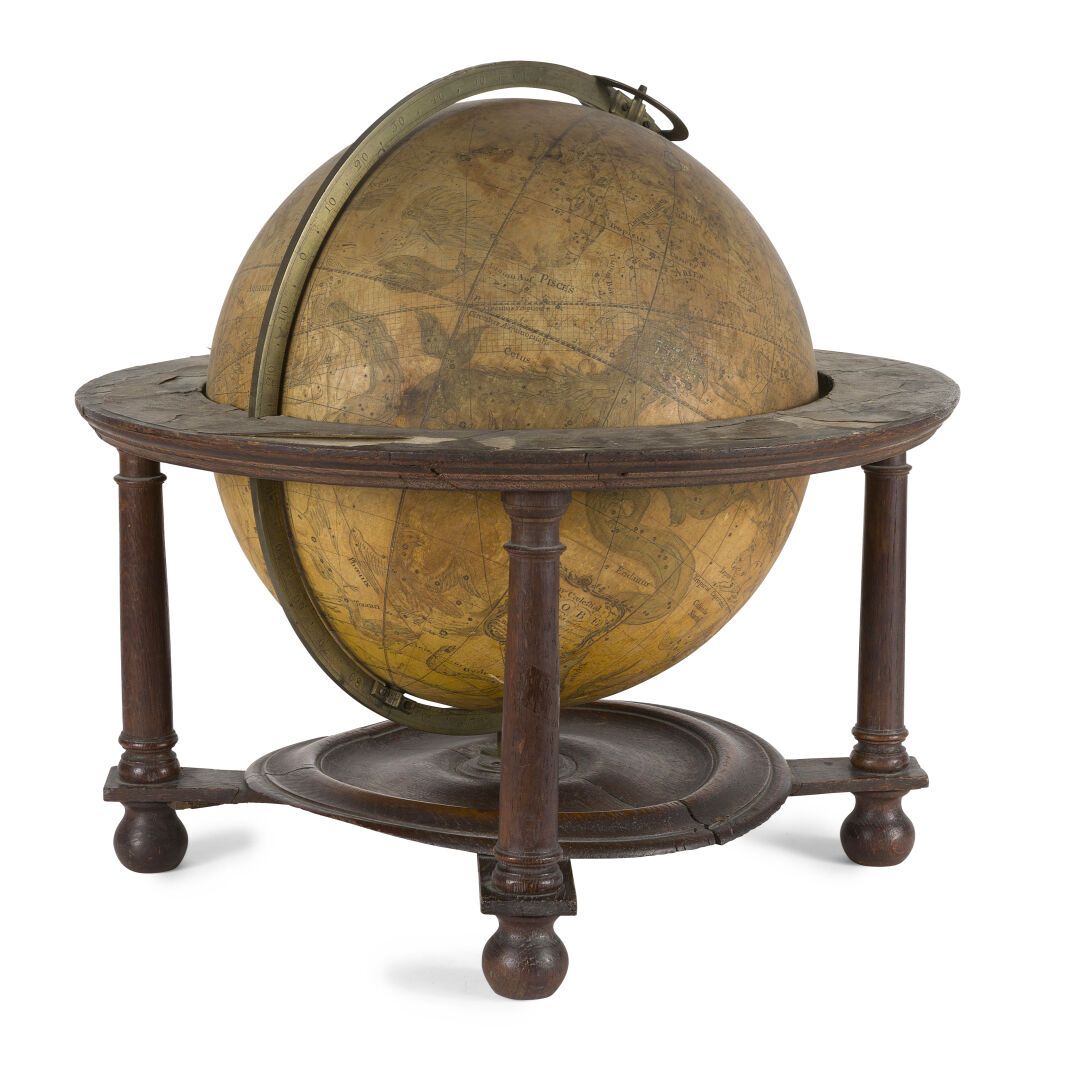
Benjamin MARTIN (1704-1782), successor to John SENEX Table celestial globe Plaster sphere composed of twelve engraved and colored paper segments, mounted in a brass meridian inside a horizon ring, resting on a natural oak base with tapered legs. The axis passing through the celestial poles supports the brass meridian arc. The constellations are represented by instruments, animals and mythological figures. Signed in the cartouche: A celestial globe. A New Caelestial Globe whereon y Stars are Carefully laid down from y Correct Observations of Mr Hevelius, Dr. Halley & By Ion Senex F.R.S. London : Now made & sold with very considerable Improvements By B. Martin in Fleet Street England, circa 1757-1770 H. 42 cm - Outside diameter: 43 cm (numerous detachments and missing parts, accidents to globe and paper, in need of complete restoration) John Senex (1678-1740), famous English cartographer and engraver, was interested in the manufacture of terrestrial and celestial globes, sold at his establishment in Salisbury Court, London (In Terrestrial and Celestial Globes, Volume 2). Benjamin Martin (1704-1782) manufactured terrestrial globes as Senex's successor, having acquired Senex globes and designs from James Ferguson in 1757.
Estimate
€800 - €1,200
Result
€2,241
Buyer's premium
30%
Benjamin MARTIN (1704-1782), successor to John SENEX
Table celestial globe
Plaster sphere composed of twelve engraved and colored paper segments, mounted in a brass meridian inside a horizon ring, resting on a natural oak base with tapered legs. The axis passing through the celestial poles supports the brass meridian arc. The constellations are represented by instruments, animals and mythological figures.
Signed in the cartouche: A celestial globe. A New Caelestial Globe whereon y Stars are Carefully laid down from y Correct Observations of Mr Hevelius, Dr. Halley & By Ion Senex F.R.S. London : Now made & sold with very considerable Improvements By B. Martin in Fleet Street
England, circa 1757-1770
H. 42 cm - Outside diameter: 43 cm
(numerous detachments and missing parts, accidents to globe and paper, in need of complete restoration)
John Senex (1678-1740), famous English cartographer and engraver, was interested in the manufacture of terrestrial and celestial globes, sold at his establishment in Salisbury Court, London (In Terrestrial and Celestial Globes, Volume 2).
Benjamin Martin (1704-1782) manufactured terrestrial globes as Senex's successor, having acquired Senex globes and designs from James Ferguson in 1757.
Sale
Monday 23 March・14:00 (Europe/Paris)
Salle 15 - Hôtel Drouot
9, rue Drouot
75009 Paris