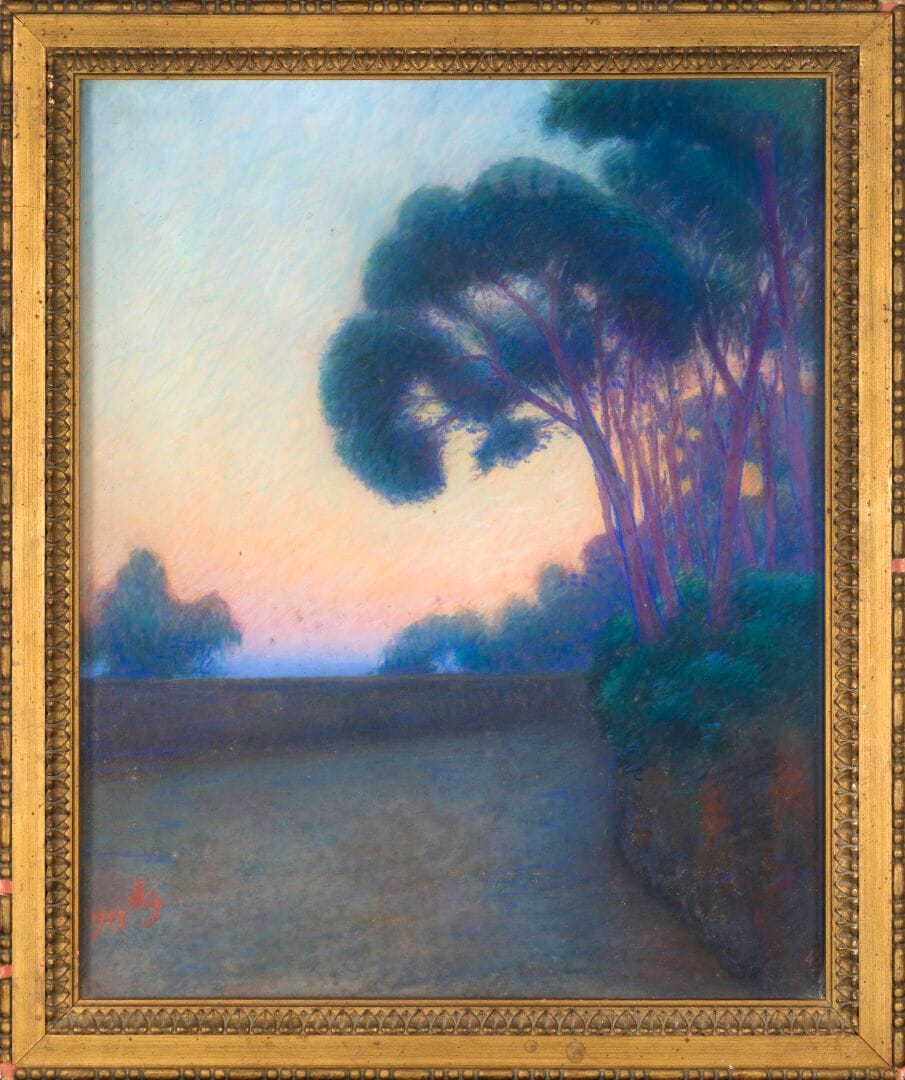
HÀM NGHI (1871-1944), known as Tử Xuân (春子) Emperor of Annam, artist in exile, also a sculptor Mustapha Road in Algiers, 1925 Pastel on paper Signed and dated lower left in red Chinese characters "春子" (Tử Xuân), 1925 Label on reverse no. 48, Galerie Mantelet exhibition, 71 rue La Boétie, Paris, November 15-27, 1926 53 x 43.5 cm (view) Provenance : Galerie Mantelet Colette Weil exhibition, Paris, 1926 Dated 1925, this pastel entitled "Route de Mustapha à Alger" fully illustrates Hàm Nghi's artistic maturity during his exile in Algeria. The uncluttered composition, structured by a low horizon line and punctuated by slender trees, opens onto a calm stretch of water bathed in twilight. The nuanced palette of blues, mauves and pinks, combined with a vaporous treatment of the sky and plant masses, reflects an atmospheric research directly linked to post-impressionist aesthetics, where color and light take precedence over description. This sensibility is combined with a contemplative approach inherited from the Far Eastern tradition, perceptible in the simplification of forms and the balance of composition. The presence on the reverse of label no. 48 identifies the work as having been included in the exhibition held at Galerie Mantelet, 71 rue La Boétie, Paris, from November 15 to 27, 1926, attesting to the artist's recognition in the Parisian milieu between the wars. Born in 1871 under the name Nguyễn Phúc Ưng Lịch, Hàm Nghi was emperor of Annam from 1884 to 1885 before becoming a figure of resistance to the French presence. Exiled to Algeria in 1888, he spent the rest of his life there, developing a singular artistic oeuvre. Trained by Western artists, he devoted himself to painting, pastels and sculpture, producing mainly landscapes imbued with poetry and restraint. Signing his works with his imperial name or the pseudonym Tử Xuân (春子), he developed a personal pictorial language, marked by an attention to light variations and a sensibility close to post-impressionism. His work, which long remained confidential, is now recognized as a major testimony to the artistic exchanges between Europe and Asia at the turn of the 20th century.
Estimate
€2,000 - €4,000
Result
€85,800
Buyer's premium
30%
HÀM NGHI (1871-1944), known as Tử Xuân (春子) Emperor of Annam, artist in exile, also a sculptor
Mustapha Road in Algiers, 1925
Pastel on paper
Signed and dated lower left in red Chinese characters "春子" (Tử Xuân), 1925
Label on reverse no. 48, Galerie Mantelet exhibition, 71 rue La Boétie, Paris, November 15-27, 1926
53 x 43.5 cm (view)
Provenance :
Galerie Mantelet Colette Weil exhibition, Paris, 1926
Dated 1925, this pastel entitled "Route de Mustapha à Alger" fully illustrates Hàm Nghi's artistic maturity during his exile in Algeria. The uncluttered composition, structured by a low horizon line and punctuated by slender trees, opens onto a calm stretch of water bathed in twilight. The nuanced palette of blues, mauves and pinks, combined with a vaporous treatment of the sky and plant masses, reflects an atmospheric research directly linked to post-impressionist aesthetics, where color and light take precedence over description. This sensibility is combined with a contemplative approach inherited from the Far Eastern tradition, perceptible in the simplification of forms and the balance of composition. The presence on the reverse of label no. 48 identifies the work as having been included in the exhibition held at Galerie Mantelet, 71 rue La Boétie, Paris, from November 15 to 27, 1926, attesting to the artist's recognition in the Parisian milieu between the wars.
Born in 1871 under the name Nguyễn Phúc Ưng Lịch, Hàm Nghi was emperor of Annam from 1884 to 1885 before becoming a figure of resistance to the French presence. Exiled to Algeria in 1888, he spent the rest of his life there, developing a singular artistic oeuvre. Trained by Western artists, he devoted himself to painting, pastels and sculpture, producing mainly landscapes imbued with poetry and restraint.
Signing his works with his imperial name or the pseudonym Tử Xuân (春子), he developed a personal pictorial language, marked by an attention to light variations and a sensibility close to post-impressionism. His work, which long remained confidential, is now recognized as a major testimony to the artistic exchanges between Europe and Asia at the turn of the 20th century.
Sale
Tuesday 23 June・13:30 (Europe/Paris)
Salle 4 - Hôtel Drouot
9, rue Drouot
75009 Paris