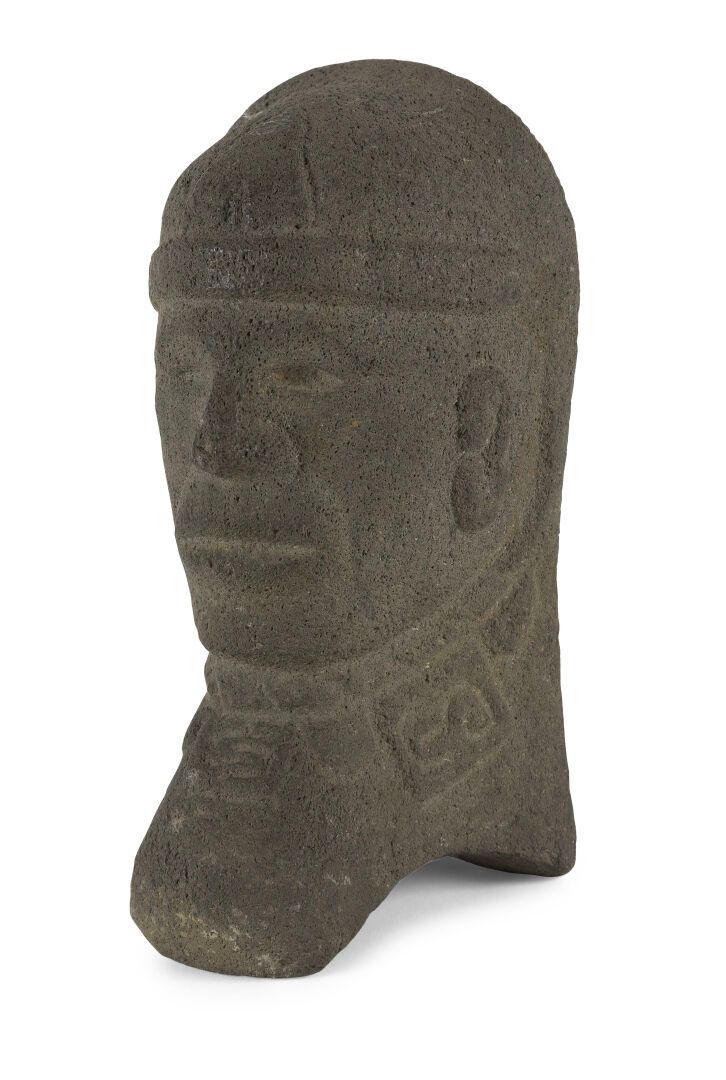
Palma representing the face of a dignitary or ball player. Its neck is adorned with a rope and a necklace made of rectangular and semicircular pendants, engraved with motifs. Palmas, along with yokes and hachas, were part of Ulama players' equipment. Numerous traces of these objects can be found in the bas-reliefs of Veracruz sites, notably El Tajin. They are shown installed on the front of the players' yoke. Older ones, such as this one, are smaller in size, with an inverted open V at the base. Gray volcanic stone Veracruz culture, Classic Period, Mexico 500-900 A.D. H. 25 - W. 12 - D. 12 cm Provenance: Castor Hara, sale at Hôtel Drouot, June 16, 2014, lot 139.
Estimate
€4,000 - €6,000
Result
Not communicated
Buyer's premium
30%
Palma representing the face of a dignitary or ball player.
Its neck is adorned with a rope and a necklace made of rectangular and semicircular pendants, engraved with motifs.
Palmas, along with yokes and hachas, were part of Ulama players' equipment. Numerous traces of these objects can be found in the bas-reliefs of Veracruz sites, notably El Tajin. They are shown installed on the front of the players' yoke.
Older ones, such as this one, are smaller in size, with an inverted open V at the base.
Gray volcanic stone
Veracruz culture, Classic Period, Mexico
500-900 A.D.
H. 25 - W. 12 - D. 12 cm
Provenance:
Castor Hara, sale at Hôtel Drouot, June 16, 2014, lot 139.
Sale
Tuesday 23 June・13:30 (Europe/Paris)
Salle 4 - Hôtel Drouot
9, rue Drouot
75009 Paris