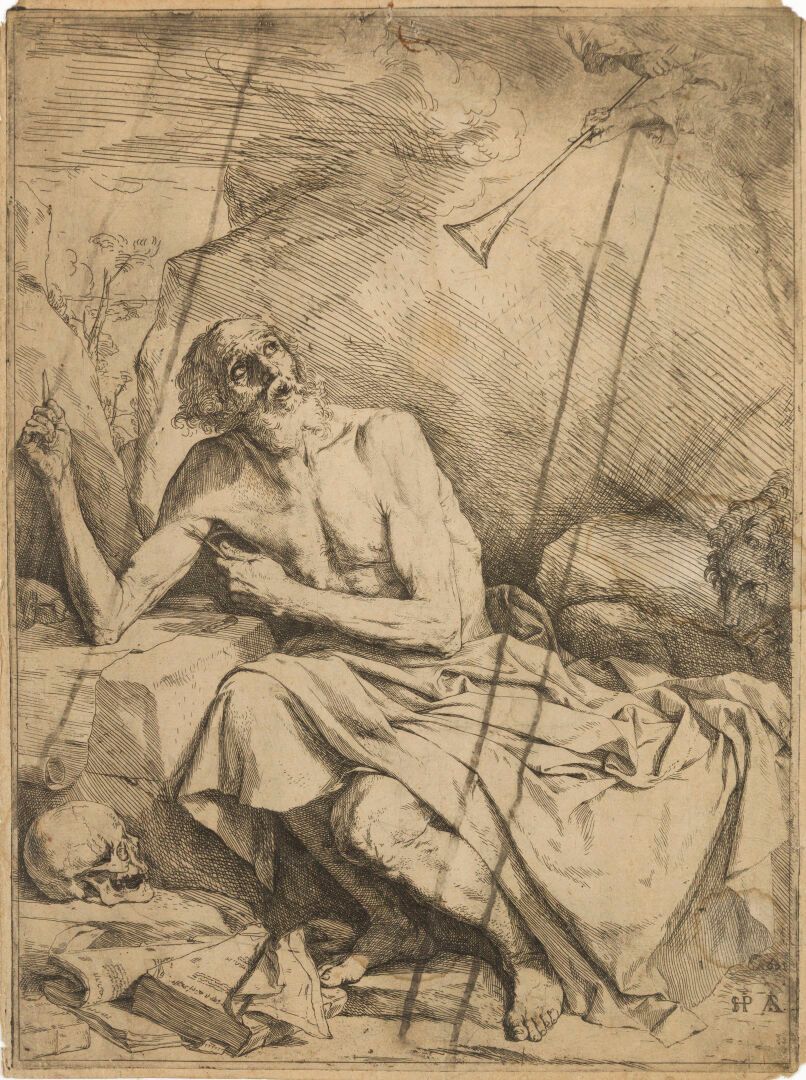
Jusepe ou José de Ribera, dit Lo Spagnoletto (1591-1652) Saint Jérôme entendant la trompette du Jugement dernier. 1621. Eau-forte, burin et pointe sèche. 238 x 322 mm. Bartsch 5 ; Brown 4. Belle épreuve sur vergé mince, avec les traces de fausse morsure très visibles, légèrement oxydée. Infimes accrocs aux bords et petits arrachements dans les angles. Auréoles d'humidité. Pli oblique médian visible au verso. Marges étroites. Au verso, paraphe répété de Pierre II Mariette avec les dates de 1668 et 1670 (Lugt 1789) à la plume et à l'encre sépia. « The plate was badly abraded before printing, with the result that long, wide blurred lines are visible in a number of places. Most prominent are two parallel lines that run from the angel's wrist through the saint's left leg. Another one runs from the clouds at the left to the bottom of the scroll. A shorter broken line is near the right edge beginnning 50 mm. from the top. In addition, there are numerous fine scratchmarks in several places, the result of careless handling of the plate as it was first being printed. All of these marks are easily visible in early impressions, when they print as black, becoming increasingly faint in later impressions. » (Jonathan Brown, Jusepe de Ribera Prints: and Drawings, Princeton University Press, Fogg Art Museum, Harvard University, 1973, p. 67). Provenance : succession du graveur Robert Cami (1900-1975).
Estimation
500 € - 800 €
Résultat
1 582 €
Frais de vente
30%
Jusepe ou José de Ribera, dit Lo Spagnoletto (1591-1652)
Saint Jérôme entendant la trompette du Jugement dernier. 1621. Eau-forte, burin et pointe sèche. 238 x 322 mm. Bartsch 5 ; Brown 4. Belle épreuve sur vergé mince, avec les traces de fausse morsure très visibles, légèrement oxydée. Infimes accrocs aux bords et petits arrachements dans les angles. Auréoles d'humidité. Pli oblique médian visible au verso. Marges étroites. Au verso, paraphe répété de Pierre II Mariette avec les dates de 1668 et 1670 (Lugt 1789) à la plume et à l'encre sépia.
« The plate was badly abraded before printing, with the result that long, wide blurred lines are visible in a number of places. Most prominent are two parallel lines that run from the angel's wrist through the saint's left leg. Another one runs from the clouds at the left to the bottom of the scroll. A shorter broken line is near the right edge beginnning 50 mm. from the top. In addition, there are numerous fine scratchmarks in several places, the result of careless handling of the plate as it was first being printed. All of these marks are easily visible in early impressions, when they print as black, becoming increasingly faint in later impressions. » (Jonathan Brown, Jusepe de Ribera Prints: and Drawings, Princeton University Press, Fogg Art Museum, Harvard University, 1973, p. 67).
Provenance : succession du graveur Robert Cami (1900-1975).
Vente
jeudi 21 mai・09:30 (Europe/Paris)
Lieu de vente à venir
79, rue de Vaugirard
75006 Paris