
LA GAZETTE DROUOT - Editor's Pick | A Great Artist for a Prestigious Commission
Bearing the mark of Jean-Henri Riesener, this chest of drawers evokes the memory of one of Louis XVI’s closest associates, the Count of Angiviller.
It was delivered in 1786 for his wife’s apartments at the Hôtel du Gouverneur, at the Château de Rambouillet.
BY CAROLINE LEGRAND
The Reign of Simplicity.
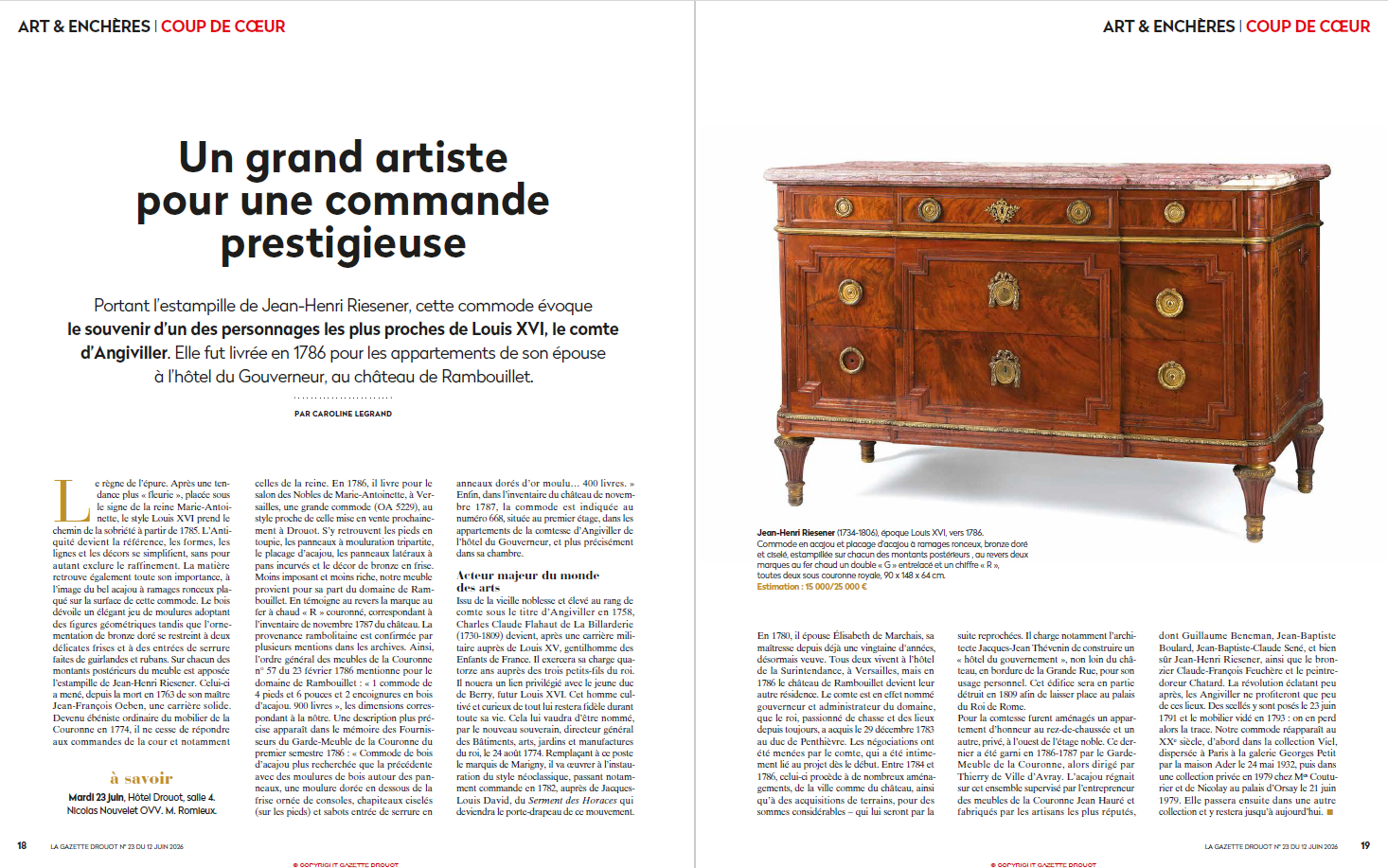
Following a more “floral” trend, epitomized by Queen Marie Antoinette, the Louis XVI style took a turn toward simplicity beginning in 1785. Antiquity became the model; forms, lines, and decorations were simplified, without sacrificing refinement. Materials also regained their importance, as exemplified by the beautiful mahogany with burl-like patterns veneered on the surface of this chest of drawers. The wood reveals an elegant interplay of moldings featuring geometric patterns, while the gilded bronze ornamentation is limited to two delicate friezes and lock plates adorned with garlands and ribbons. Jean-Henri Riesener’s mark is affixed to each of the piece’s rear legs. Since the death of his master, Jean-François Oeben, in 1763, Riesener had built a solid career.
Having become the official cabinetmaker for the Crown in 1774, he consistently fulfilled commissions from the court, particularly those from the queen. In 1786, he delivered a large chest of drawers (OA 5229) for Marie-Antoinette’s Salon des Nobles at Versailles, in a style similar to the one soon to be offered at Drouot. It features spindle legs, panels with tripartite molding, mahogany veneer, side panels with curved sides, and a bronze frieze decoration. Less imposing and less ornate, our piece comes from the Rambouillet estate. This is evidenced on the reverse by the hot-stamped mark of a crowned “R,” which corresponds to the castle’s November 1787 inventory. Its Rambouillet provenance is confirmed by several references in the archives. For example, the general inventory of Crown furniture No. 57, dated February 23, 1786, lists the following for the Rambouillet estate: “1 chest of drawers measuring 4 feet 6 inches and 2 corner cabinets made of mahogany. 900 livres,” with dimensions matching those of our piece. A more precise description appears in the report of the Suppliers to the Crown’s Furniture Depot for the first half of 1786: “ A mahogany chest of drawers more refined than the previous one, with wooden moldings around the panels, a gilded molding below the frieze adorned with consoles, chiseled capitals (on the legs), and lock plates with rings gilded with ground gold… 400 livres.”
Finally, in the castle’s inventory from November 1787, the chest of drawers is listed as number 668, located on the first floor in the apartments of the Countess d’Angiviller at the Hôtel du Gouverneur, and more specifically in her bedroom.
A Major Figure in the Art World
Born into the old nobility and elevated to the rank of count under the title of Angiviller in 1758, Charles Claude Flahaut de La Billarderie (1730–1809) became, after a military career serving Louis XV, a gentleman-in-waiting to the Children of France. He served in this capacity for fourteen years, working with the king’s three grandsons.
He formed a special bond with the young Duke of Berry, the future Louis XVI. This cultured man, curious about everything, remained loyal to him throughout his life. This earned him an appointment by the new sovereign as Director General of the King’s Buildings, Arts, Gardens, and Manufactories on August 24, 1774. Replacing the Marquis de Marigny in this position, he worked to establish the Neoclassical style, notably commissioning Jacques-Louis David in 1782 to paint *The Oath of the Horatii*, which would become the flagship work of this movement.
In 1780, he married Élisabeth de Marchais, who had been his mistress for some twenty years and was now a widow. The couple lived at the Hôtel de la Surintendance in Versailles, but in 1786 the Château de Rambouillet became their second residence. The count was in fact appointed governor and administrator of the estate, which the king—who had always been passionate about hunting and the area—had acquired on December 29, 1783, from the Duke of Penthièvre. The negotiations were led by the count, who had been closely involved in the project from the outset. Between 1784 and 1786, he undertook numerous improvements to both the town and the château, as well as land acquisitions, at considerable expense—for which he would later be criticized. In particular, he commissioned the architect Jacques-Jean Thévenin to build a “government mansion” not far from the castle, on the edge of the Grande Rue, for his personal use. This building was partially demolished in 1809 to make way for the Palace of the King of Rome.
For the countess, a state apartment was furnished on the ground floor and another, private one, to the west of the main floor. The latter was furnished in 1786–1787 by the Garde-Meuble de la Couronne, then headed by Thierry de Ville d’Avray. Mahogany dominated this collection, which was overseen by the Crown’s furniture contractor Jean Hauré and crafted by the most renowned artisans, including Guillaume Beneman, Jean-Baptiste Boulard, Jean-Baptiste-Claude Sené, and of course Jean-Henri Riesener, as well as the bronze castor Claude-François Feuchère and the painter and gilder Chatard. With the Revolution breaking out shortly thereafter, the Angiviller family enjoyed these premises for only a short time. The premises were sealed on June 23, 1791, and the furnishings were removed in 1793; after that, all trace of them was lost. Our chest of drawers reappeared in the 20th century, first in the Viel collection, which was auctioned off in Paris at the Georges Petit Gallery by the Ader auction house on May 24, 1932, then in a private collection in 1979 at the auction held by Mes Couturier and de Nicolay at the Palais d’Orsay on June 21, 1979. It subsequently passed into another collection, where it has remained to this day.
Jean-Henri Riesener (1734–1806), Louis XVI period, circa 1786.
Mahogany chest of drawers with burl mahogany veneer, gilded and chiseled bronze, stamped on each of the rear legs; on the reverse, two hot-iron marks: an interlaced double “G” and the letter “R,” both beneath a royal crown; 90 x 148 x 64 cm.
Estimate: €15,000–25,000
Auction on June 23, 2026, at the Hôtel Drouot, Room 4 – Lot 264
Expert: Arnaud Romieux