
20260921094111.jpg)
20260624110312.jpg)
20260624110429.jpg)
20260624110456.jpg)
20260624110404.jpg)
20260522113546.jpg)
20260522113514.jpg)
20260522113443.jpg)
20260402153636.jpg)
20260402161907.jpg)
20260402161747.jpg)
20260402160549.jpg)
20260402160823.jpg)
20260402161959.jpg)
20260312124237.jpg)
20260402162459.jpg)
20260402162351.jpg)
20251217152922.jpg)
20251217152900.jpg)
20251217152953.jpg)
20251203094902.jpg)
20251203094557.jpg)
20250620151651.jpg)
20250620151606.jpg)
20250422161634.jpg)
20240416094551.jpg)
20241021104355.jpg)
20240416094338.jpg)
20241223115008.jpg)
Sales Schedule
News
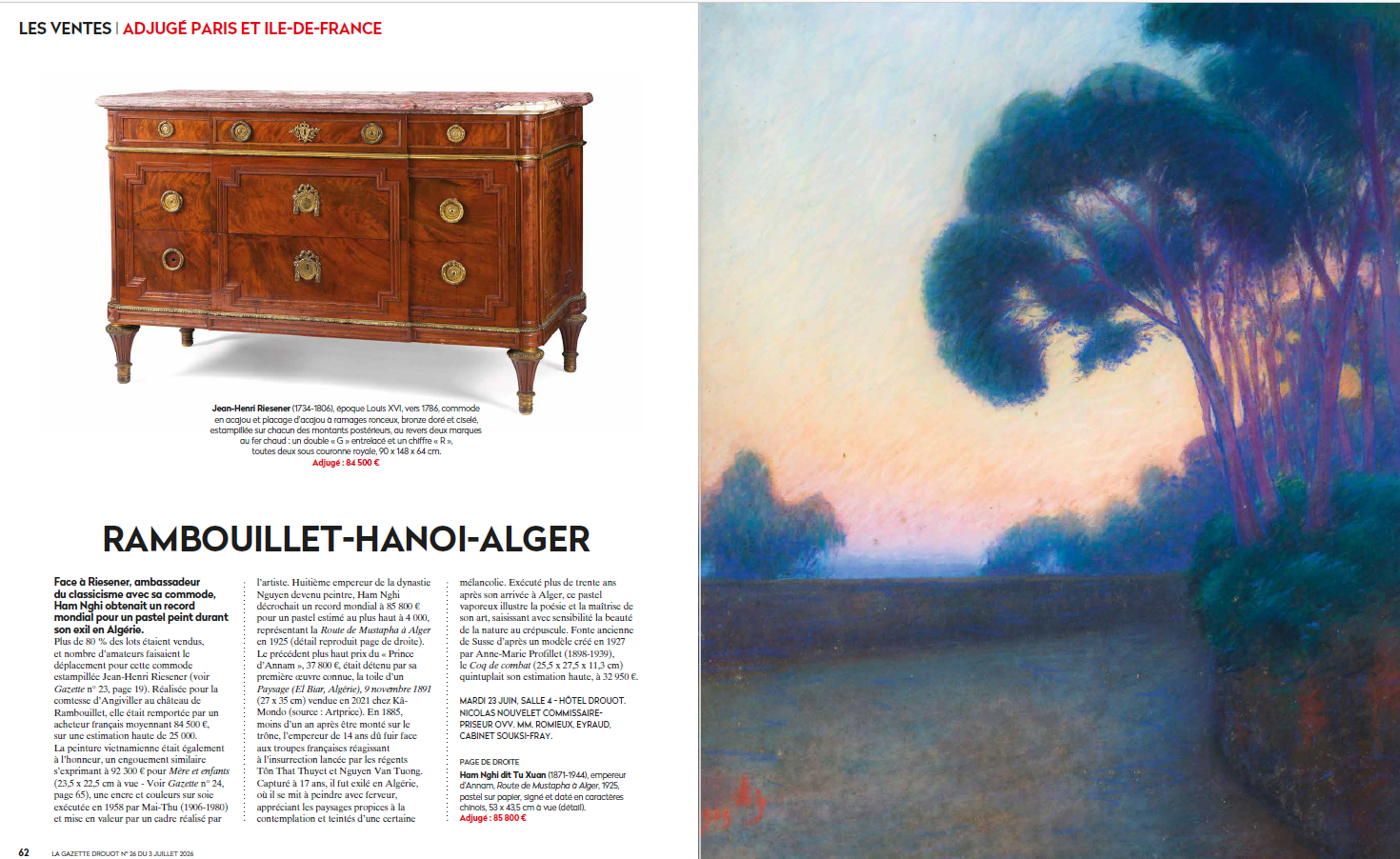
LA GAZETTE DROUOT | AUCTIONS | AUCTION RESULTS IN PARIS AND THE ÎLE-DE-FRANCE REGION
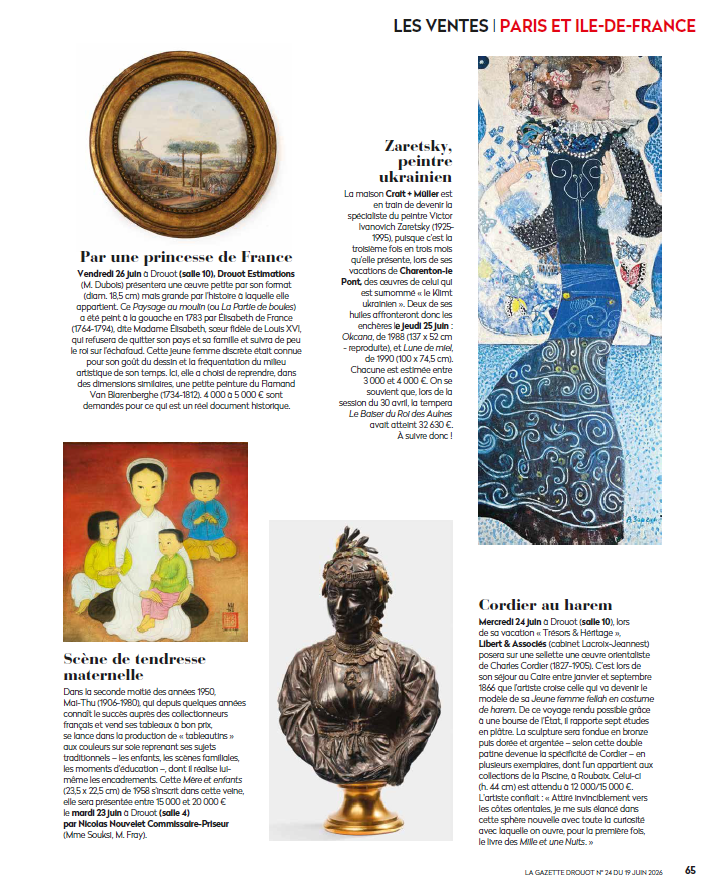
THE DROUOT GAZETTE | AUCTIONS IN PARIS AND THE ÎLE-DE-FRANCE REGION
LA GAZETTE DROUOT | Press Release
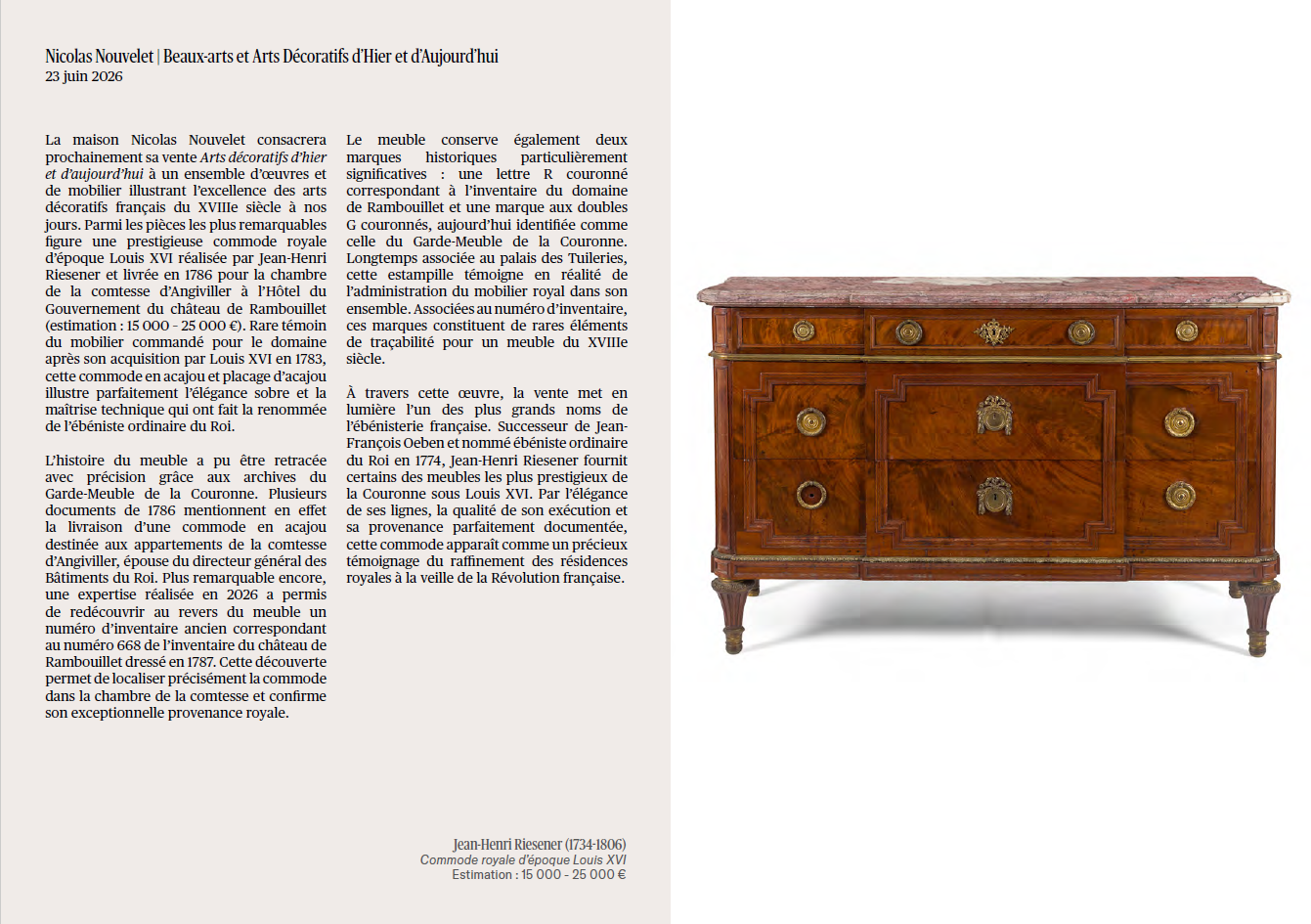
Nicolas Nouvelet will soon dedicate its “Decorative Arts of Yesterday and Today” auction to a collection of works and furnishings that showcase the excellence of French decorative arts from the...
LA GAZETTE DROUOT - Editor's Pick | A Great Artist for a Prestigious Commission
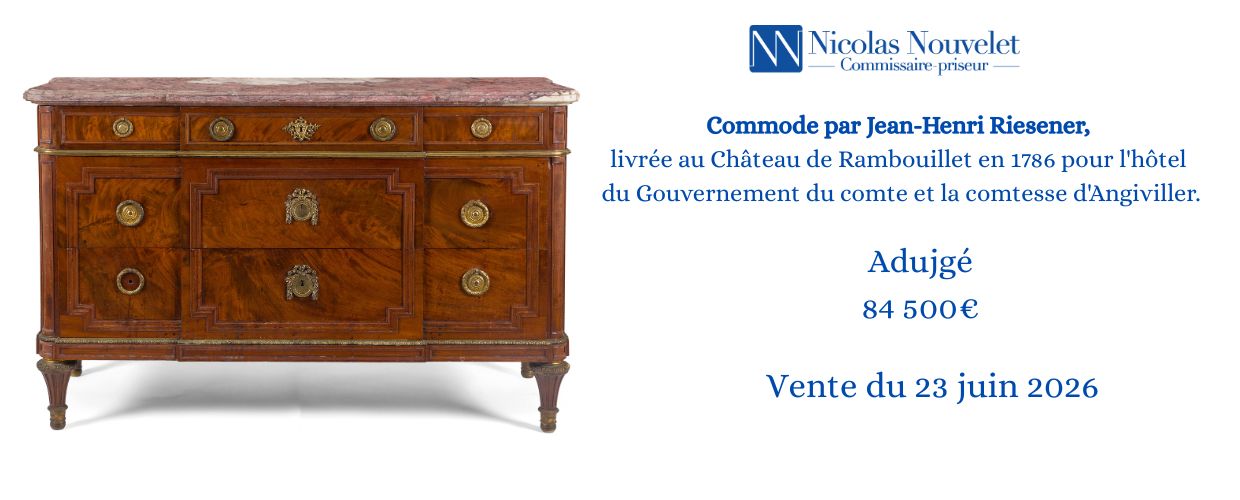
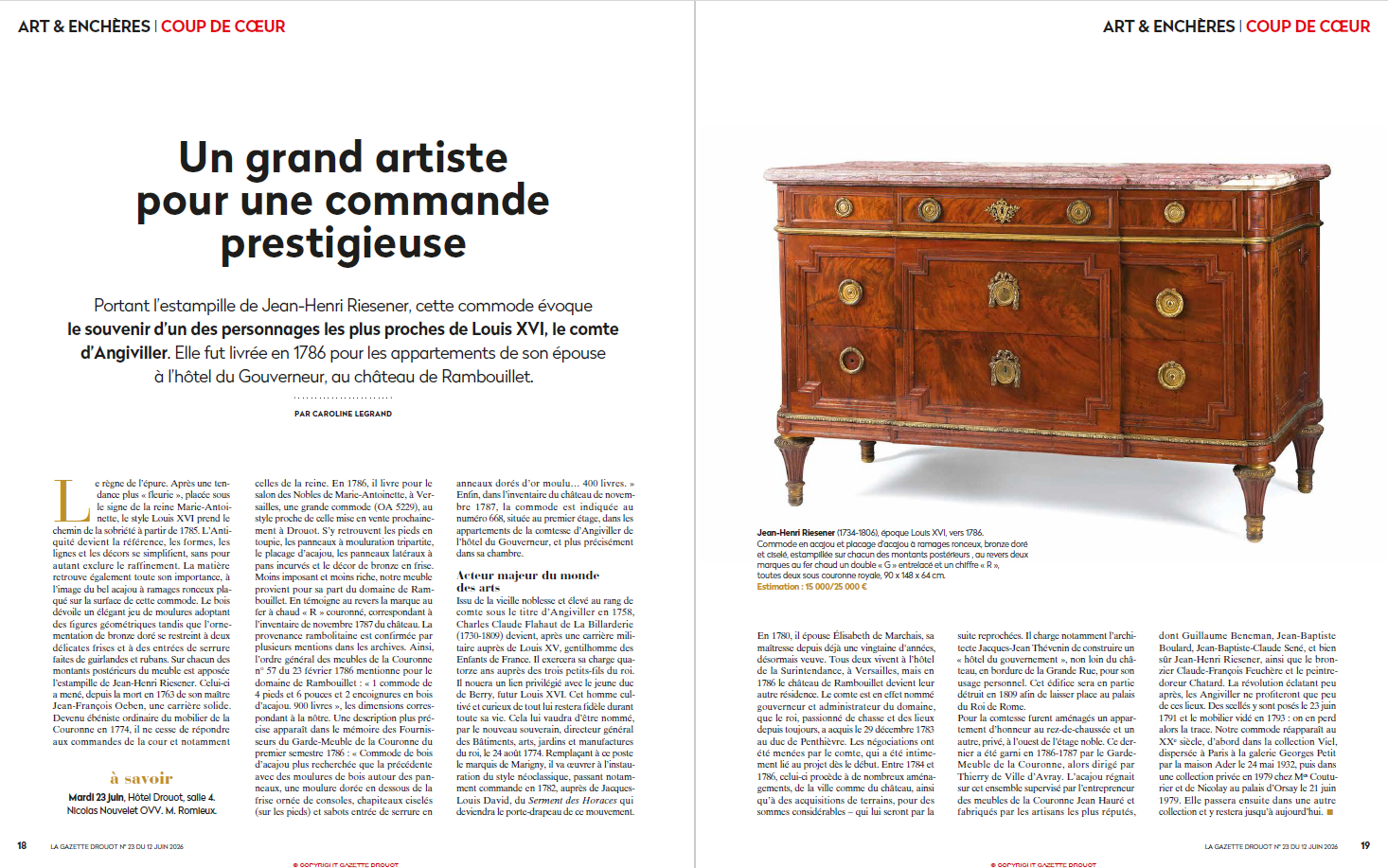
Bearing the mark of Jean-Henri Riesener, this chest of drawers evokes the memory of one of Louis XVI’s closest associates, the Count of Angiviller. It was delivered in 1786 for his wife’s...
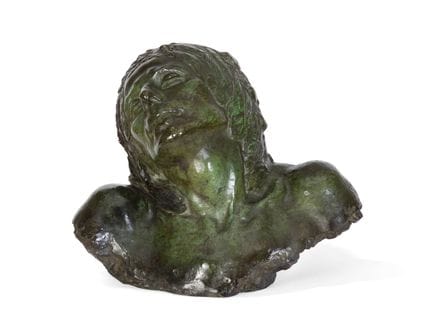
SÉRAPHIN SOUDBININE (1867-1944) (SERAFIM NIKOLAYEVICH (GOLOVASTIKOV) SUDBININ, DIT) Anna Pavlova dans La Mort du Cygne, le modèle créé en [1913], porte un n° 01 Sculpture. Épreuve en bronze patiné vert antique nuancé. Fonte d'édition ancienne. Signée et située SOUDBININE London et porte la mention 01 (numérotation ?) sur l'épaule gauche et porte le cachet de Alexis RUDIER Fondeur Paris à l'arrière. 31,5 x 43 x 25 cm Provenance : Collection X., Paris. Descendant de Pierre Pitoëff (c. 1880-1962). Pierre Pitoëff, célèbre costumier de théâtre et frère de Georges Pitoëff (1884-1939), acteur et décorateur de théâtre, tous deux d'origine russe. À noter : En 1905, le danseur et chorégraphe Michel Fokine (1880-1942) crée pour la danseuse étoile Anna Pavlova le ballet La Mort du Cygne inspiré du Cygne du Carnaval des animaux de Camille Saint-Saëns (1835-1921). La chorégraphie de ce ballet évoque les derniers moments d'un cygne. Joué pour la première fois en 1907 au Théâtre Mariinsky, à Saint-Pétersbourg, Anna Pavlova continuera de danser ce ballet mythique jusqu'à la fin de sa vie. L'attitude de ce buste rappelle ainsi, en plus du costume de Pavlova, l'issue de ce ballet qui voit le cygne finalement vaincu par la mort, la tête dignement déposée entre ses ailes. Collections publiques et oeuvres en rapports : - Fine Arts Museum of San Francisco, California Palace of the Legion of Honor, San Francisco - Une épreuve en bronze de notre modèle de sculpture est conservée dans cette institution sous le numéro d'inventaire T&D 1962.141. - Bibliothèque-musée de l'Opéra, Paris - Une variante en marbre blanc du modèle de notre sculpture est conservée dans cette institution sous le numéro d'inventaire MUSEE-887. - Archives d'État de la littérature et de l'art (РГАЛИ), Moscou - Deux photographies d'époque montrant une variante en marbre et une épreuve en terre de notre modèle de sculpture sont conservées dans cette institution sous les numéros d'inventaire Ф. 2741. Оп. 1. Ед. хр. 4. Л. 1-2 et 3-4. Archives et oeuvres en rapport : - Catalog of American Portraits, National Portrait Gallery & Smithsonian, Washington - L'épreuve en bronze de notre modèle de sculpture conservée à San Francisco est répertoriée dans ce catalogue sous le numéro d'inventaire T&D1962.141 LH. - National Portrait Gallery, Photographs Collection, Londres - Notre sculpture à rapprocher d'une photographie de Frans van Riel intitulée Anna Pavlova in 'The Dying Swan' (c. 1928), conservée dans cette institution sous le numéro d'inventaire NPG x139574. Exposition et oeuvre en rapport : Pavlova, A Commemorative Exhibition Celebrating the Dancer's Art - Fine Arts Museum of San Francisco, California Palace of the Legion of Honor, San Francisco, du 31 janvier au 26 avril 1981. L'épreuve en bronze de notre modèle de sculpture conservée à San Francisco fut exposée lors de cette manifestation. Bibliographie et oeuvres en rapport : - The Sketch - N° 1069 du 23 juillet 1913. Une photographie montrant Anna Pavlova posant devant Soudbinine pour la réalisation de ce buste est reproduite en couverture. - Ekaterina Khmelnitskaya - Serafim Soudbinine, at the turning point : from Art Nouveau to Art Déco - Éditions Tabula Rasa, Saint-Pétersbourg, 2010. Une épreuve en biscuit de notre modèle de sculpture est reproduite page 30, sous le numéro 45 ; l'épreuve en bronze de notre sculpture conservée à San Francisco est reproduite page 39, sous le numéro 59 ; une variante en marbre et une épreuve en terre sont reproduites page 28, sous les numéros 42 et 43. Deux photographies montrant Anna Pavlova posant devant Soudbinine pour ce buste sont reproduites pages 25 et 26, sous les numéros 37 et 38. - Sculptural, Plastique : Serafim Soudbinine - Catalogue de l'exposition organisée à Nijni Novgorod, du 18 mai au 30 juin 2023. Une variante en marbre de notre modèle de sculpture est reproduite page 75, sous le numéro 28 du catalogue, et une épreuve en terre reproduite page 76, sous le numéro 29.
Result
50,232 EUR
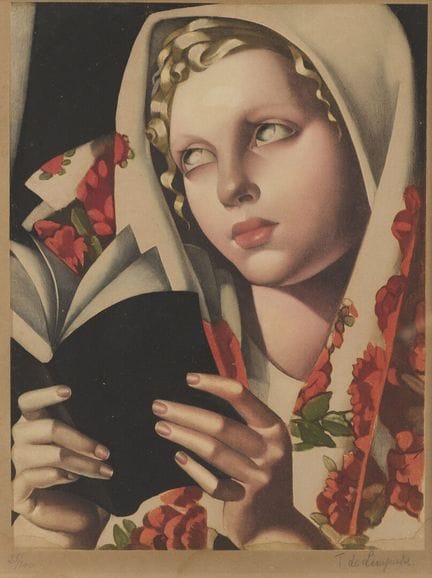
Tamara de Lempicka (1898-1980) The Polish woman. 1933. Aquatint. Sight: 285 x 370 mm. Printed in colors. Good proof on chine applied on vellum, numbered and signed in pencil. Strong oxidation and moisture rings in the lower part of the subject. Margins. Edition of 200 proofs. Framed.
Result
17,864 EUR
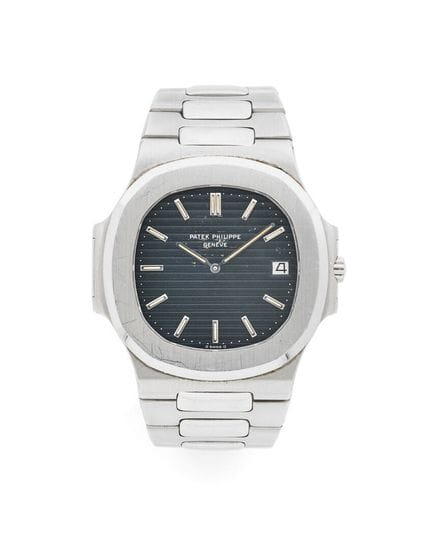
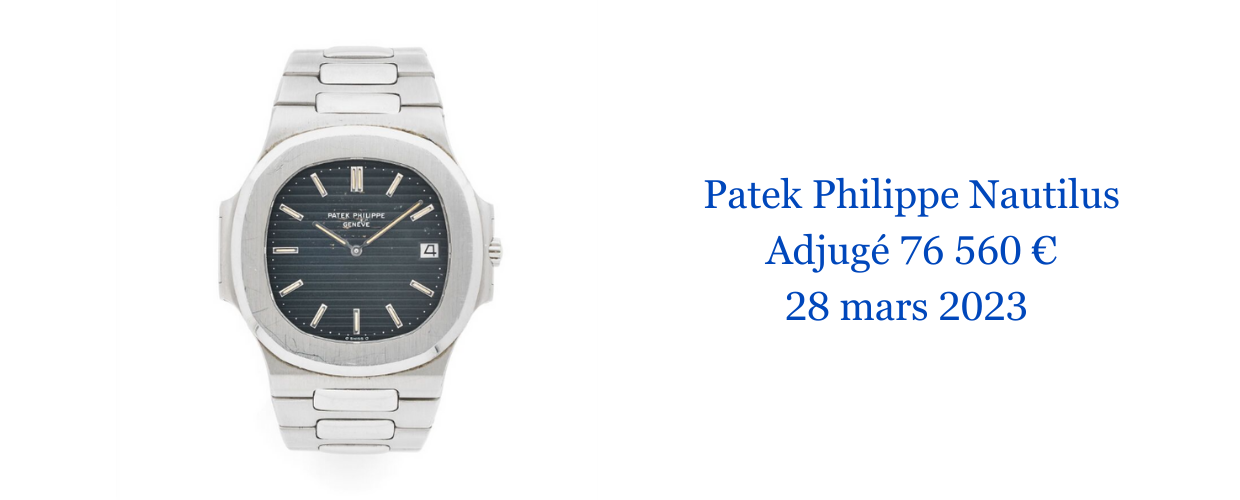
PATEK PHILIPPE NAUTILUS Ref 3700 / 1 Men's stainless steel wristwatch, anthracite sigma dial, luminous applied hour markers, date window at 3 o'clock, self-winding mechanical movement, stainless steel bracelet with signed folding clasp. Size 42 mm x 44 mm Condition Report: The dial is slightly faded around 9 o'clock. The movement works but we advise to plan a revision. Micro scratches of use on the case and the bracelet. The hands do not move while the movement is working. Condition Report: The dial is slightly faded around 9 o'clock. The movement works but the hands are not moving, we recommend servicing. Minor scratches from use on the case and bracelet. In order to bid on this lot n°204, please contact the study, no bidding via Drouot Live.
Result
76,560 EUR
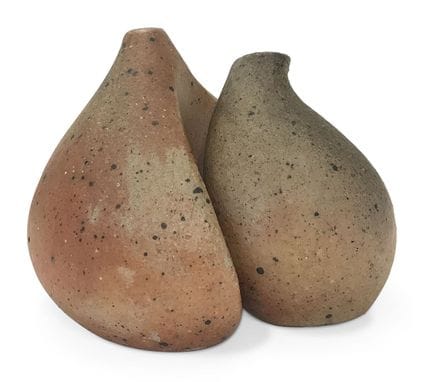
ELISABETH JOULIA (1925-2003) Chestnuts, from the series made between 1961 and 1970 Sculpture, which can form vase, in two elements. Proof in stoneware pyrity. Each element signed JOULIA towards the base. H. 17,5 cm - L. 19 cm - W. 12 cm H. 15,5 cm - L. 14 cm - W. 12 cm Exhibition and bibliography : Joulia - Ceramics/sculptures 1950 / 1983 - Exhibition at the museum of Saint-Amand-les-Eaux, October-November 1983. Several works of this series Les Châtaignes exposed at the time of this demonstration and carried in the catalog, published on this occasion by the museum, under the numbers 24 to 28, the number 28 reproduced page 15.
Result
10,208 EUR
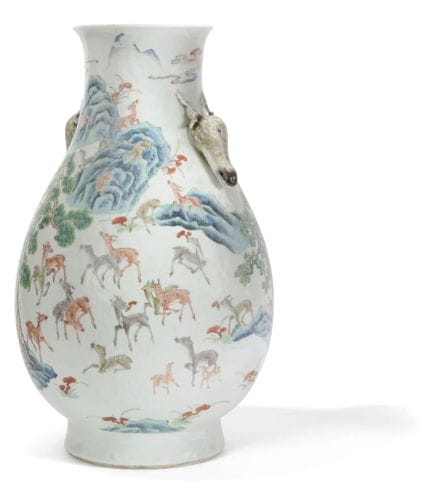
Un vase « aux cent daims » A vase of baluster form In white porcelain enamelled in polychrome with a decoration known as "one hundred deer", the deer evolving in a landscape of rocks, "lingzhi" mushrooms, "pine trees" and "wutong". The neck is flanked by two handles molded in the shape of a deer head. Apocryphal Yongzheng mark in blue on the cover. China, 19th century H. 45 cm (On one side, a slight missing ear and a missing wood, on the other side, two woods are missing, as well as a missing ear).
Result
7,911 EUR
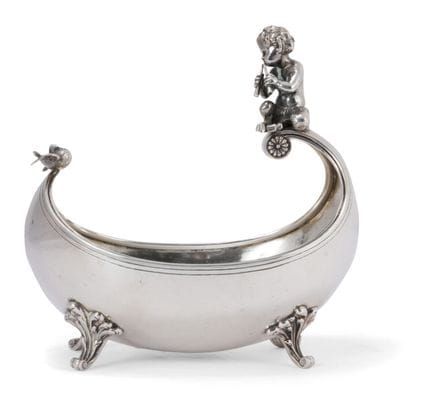
FABERGÉ Coupe en argent. Moscou, 1893 FABERGÉ Silver cup. Moscow, 1893 Quadripodal cup in the form of a nave, on the "stern" a faun playing the panpipes faces a bird on the "bow". Hallmarks: 88, Moscow, 1893, controller "Л.О" (Lev Friedrikhovich Oleks) and "К.ФАБЕРЖЕ" mark of the firm of Karl Fabergé in Moscow, under the eagle of supplier to the Court. (Small edge shock, slight dent in one foot). H. 16,5 cm-P. 11,5 cm-L. 16,5 cm Weight : 531 g
Result
7,018 EUR
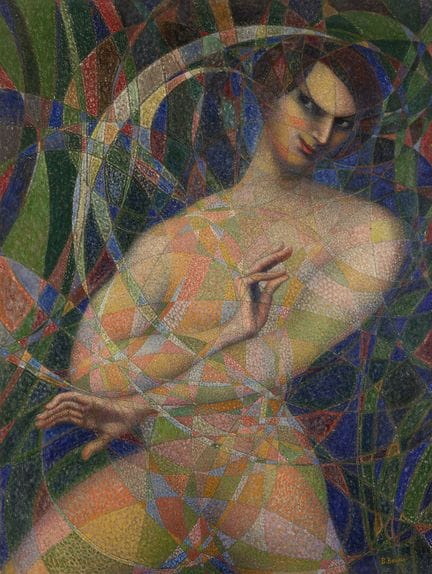
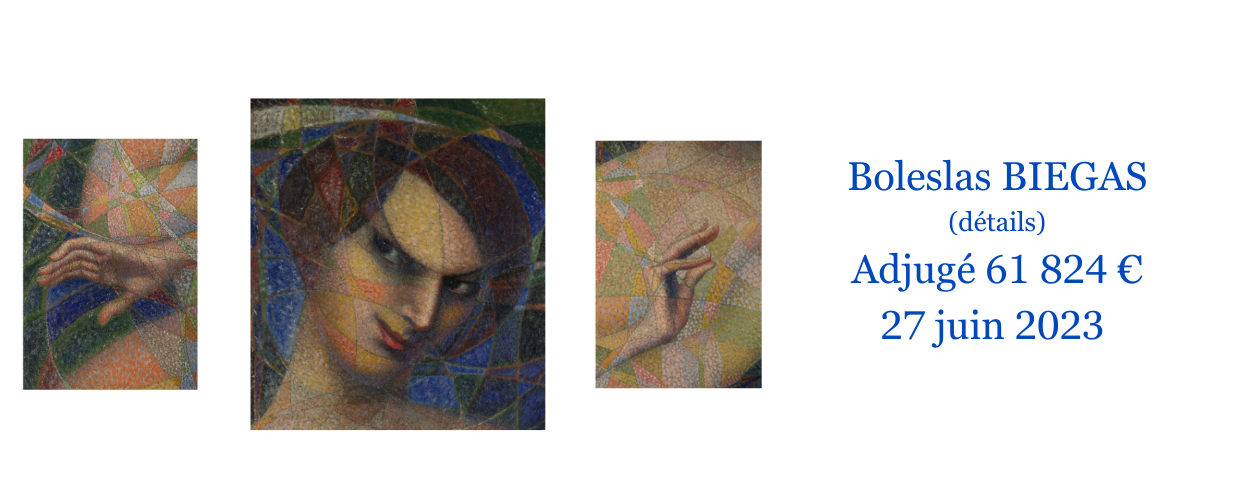
Boleslas Biegas probably began painting his first spherical paintings in1912. Guillaume Apollinaire, on the occasion of his exhibition organized from the 21st of June to the 5th of July by the Amicale des Arts, in the Femina Theatre avenue des Champs Élysées, remarked on the circular elements in his paintings in L’Intrangiseant dated June 28th : “The firmament to which his fervor raises him is populated by beings in symbolic colors, in beautiful and simple shapes to which the artist imprints his melodious spherical movement. This elevated art, that should be linked with religious art, is worthy of attention”. Biegas will only start using the term “sphérisme” after WWI, during his participation at the Exposition des artistes Peintres et Sculpteurs Polonais, a fundraiser for the Polish soldiers wounded in France, open to the public on November 30th, 1918 in the Palace of the Count Nicolas Potocki, 27 avenue de Friedland, and to which Biegas had sent 49 paintings and 7 sculptures. In the catalog of the exhibition, 6 pieces are preceded by the statement “Biegas’s invention of spherical paintings”. Biegas painted more than a hundred spherical paintings which he presented at the Salon d’Automne of 1919, at the Salon des Indépendants in 1920, 1921, 1922 and 1923, and especially at the Pavillon de Magny, located 55 avenue Victor Hugo. Unfortunately, no catalog of this exhibition entirely dedicated to spherism was ever published. However, several articles make it possible to establish that it took place from the 20th of March to the beginning of May 1919 and that it included about forty paintings. Spherism had a real impact on the Parisian artistic scene then, as shown by the articles from Pascal Forthuny, Michel Georges-Michel, Gustave Kahn, Louis Vauxcelles and Claude Chauvière. L’Éclair’s columnist entitled his article dated March 20th : “Art or mystification ? Cubism is dead ! We now know “spherism”…which would almost make us regret its predecessor!” In l’Heure dated May 19th, Claude Chauvière entitles his article “Round-Round” and defined Biegas as “the master of circles” : “Biegas sees everything round and he explains it logically : the Earth is round, the moon is round : humans have brain convolutions, blood circulation and the belt-railway make the circular motion uniform ; liquids’ concave or convex menisci ; the spheroidal embryo ; the sound that spreads through waves, sensibility which is projected and perceived through waves, etc…” Until 1914, Biegas had not shown any kind of interest for the motion of the human body. After WWI, dance occupied a special place in spherism, as well as in the Mystique de l’Infini. The Danse du Mépris perfectly illustrates Biegas’ art’s new orientation, which gave rise to connections that had not yet been explored. In the early 20’s, Biegas was very close to the American dancer Paul Swan “ The Most Beautiful Man in the World”(1) who was very successful with Isadora Duncan and animated his parties in his studio on rue Bagneux. Biegas also knew Jan Reszke, who was approached by Vaclav Nijinsky in 1919 to get Polish citizenship. Starting in 1917, Nijinsky realized drawings based on circles that present, for some of them, astonishing kinship with Spherism. It is difficult to date the Danse du Mépris with precision because Biegas signed his paintings but never dated them, unlike his sculptures. We can assume that the Danse du Mépris was painted around 1922-1925 because after 1925, Biegas only exposed paintings from the Mystique de l’Infini. Xavier Deryng
Result
61,824 EUR
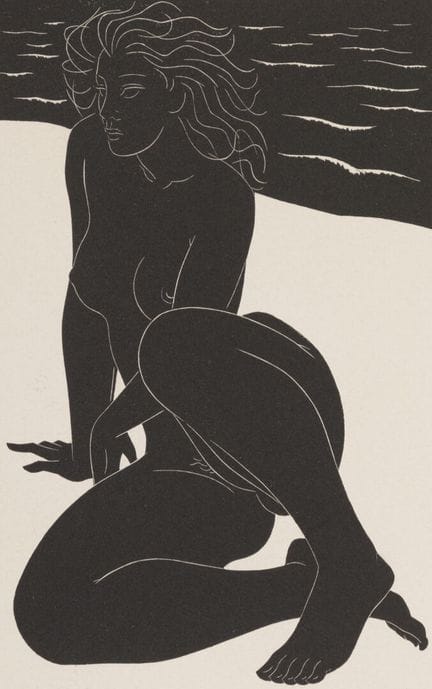
Jacques Boullaire (1893-1976) Ariadne. Woodcut. [250 x 330 mm]. Perfect proof on white vellum, numbered and signed, then annotated at the foot. Full margins. Edition of 60 proofs. Tahitienne allongée dans l'herbe. Drypoint. 245 x 174 mm. Fine proof on strong cream vellum, oxidized. Light moisture rings along lower edge. Full margins. Set. 2 p.
Result
1,932 EUR
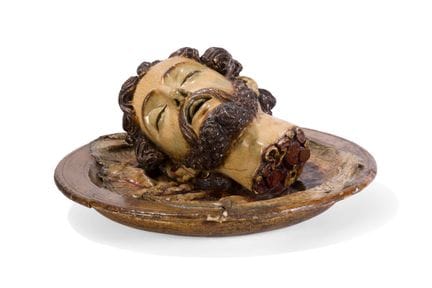
Tête de saint Jean-Baptiste posée sur un plat, en bois sculpté en ronde-bosse, polychromé et doré avec le linge en toile marouflée ; détails très naturaliste tant dans la sculpture que la polychromie, avec section du cou laissant apparaître les artères, et couleur verdâtre de la tête. Italie du sud, fin du XVIIe siècle D. : 46 cm (petits accidents, reprises à la polychromie)
Result
31,344 EUR
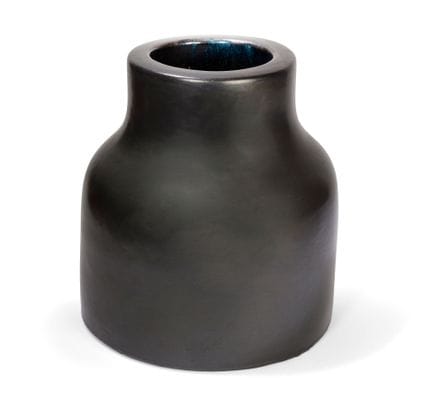
GEORGES JOUVE (1910-1964) Very large vase; the cylindrical base has a shoulder and ends in a large annular neck. Black glazed ceramic proof. Circa 1955-1958. Signed JOUVE and the monogram A. P. (with interlaced letters) for Apollon, the so-called Alpha mark, on the reverse underglaze. H. 30 cm - D. base: 28 cm Minor enamel shrinkage around the base. Bibliography Preface by Pierre Bergé, texts by Philippe Jousse and Norbert Pierlot - Georges Jouve - Éditions Jousse Entreprise, Paris, 2005. Identical models reproduced on pages 287 and 288 (1957 and 1958 exhibition stands).
Result
71,500 EUR
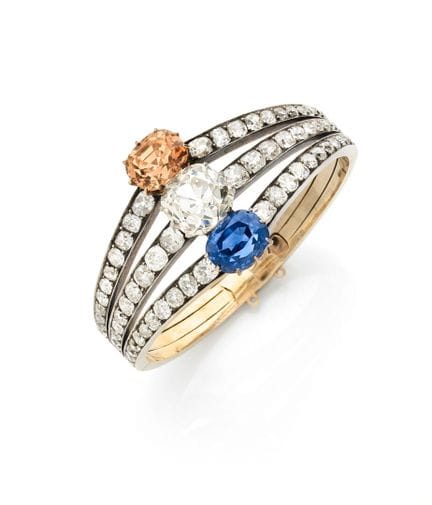
Important bracelet in yellow gold 750 ‰ and silver 800 ‰. It is rigid opening and composed of three lines set with a total of 64 old-cut brilliants in slight fall for a weight of +/- 14 carats. Centered by a large 10.24-carat M/VS1 old-cut cushion diamond, shouldered on either side by a 9.17-carat cushion-shaped blue Ceylon sapphire without thermal modification and a 9.13-carat cushion-shaped orange Ceylon sapphire without thermal modification. Total weight: 60.2 g Work circa 1850 (The three stones are accompanied by their LFG certificate dated 11/12/2023 attesting to their quality and origin). Provenance : Mrs. G.'s case This bracelet has belonged to the same French family since its origin. To bid on this lot, please contact the Auction House in advance.
Result
175,500 EUR
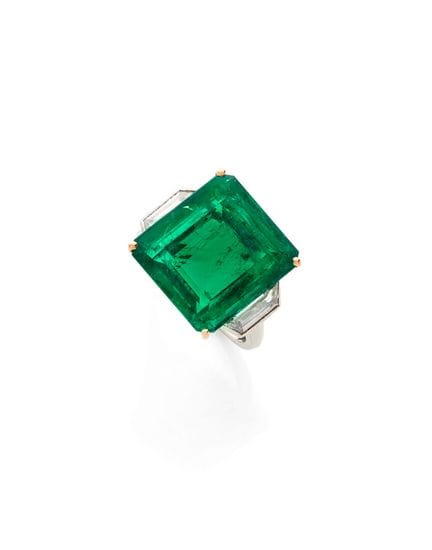
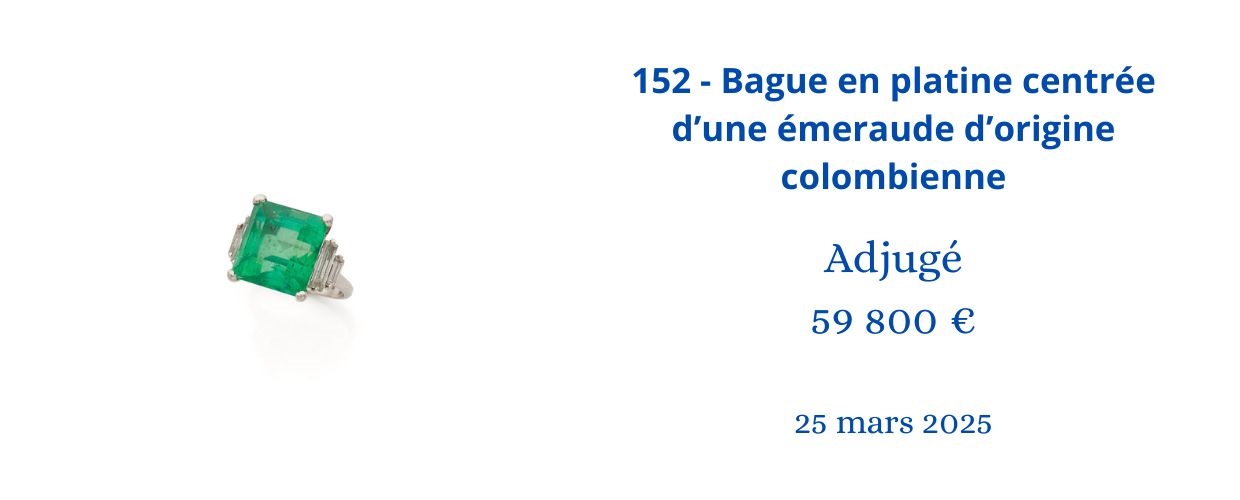
Large Colombian emerald Ring formed of a platinum 850 ‰ and yellow gold 750 ‰ claw setting, centered with a large square emerald with slightly cut sides, +/- 9.70 carats of beautiful transparency and luminous green. It is accompanied by its LFG certificate dated 11/12/2023 specifying a minor oil treatment (Minor oil) F1. The emerald is set on either side with a trapeze diamond. PB: 6.45 g - TDD: 51
Estimate
25,000 - 35,000 EUR